US Treasury spread betting lets you trade movements in US government debt markets without buying the securities themselves. Your profit or loss depends on the quoted price change and your stake per point. You can take a position on rising or falling prices, but leverage can turn a modest market move into a substantial account loss.
The first distinction matters more than any trading signal: a Treasury price is not a Treasury yield. Buying a price based Treasury market usually expresses a view that yields will fall. Buying a yield based market expresses the opposite view. Check which one appears on the dealing ticket before committing money.
What does a US Treasury spread bet track?
A Treasury spread bet is a contract with your provider. You do not lend money to the US government, receive ownership of a Treasury security or acquire a bondholder’s right to repayment. Instead, you trade changes in the provider’s quoted market. The wider guide to bond spread betting markets covers how this differs from holding government debt directly.
The underlying securities come in several forms. Treasury bills mature within a year; Treasury notes are issued with maturities of two, three, five, seven and ten years; Treasury bonds are issued for twenty or thirty years. Notes and bonds pay interest every six months. These categories appear in the US Treasury’s description of marketable securities.
For a spread bet, however, the market name is only the starting point. Establish whether the quote references a cash security, a Treasury futures contract or another defined benchmark. A label such as “US 10 Year” does not, by itself, tell you the settlement method, point size or expiry arrangements.
Conventional Treasury futures have delivery rules covering eligible securities rather than simply tracking the latest bond issued at that maturity. The security that is cheapest to deliver can strongly influence the futures price. Classic Treasury bond futures and Ultra Treasury bond futures also have different delivery maturity ranges, despite both providing exposure to longer dated debt. The CME Treasury futures contract and delivery guide sets out these distinctions.
The practical consequence is straightforward: analyse the instrument you will actually trade. A cash yield chart, a futures chart and a provider’s spread betting chart need not show identical levels. For the mechanics shared across bond markets, see how bond spread betting works.
Treasury prices, yields and trade direction
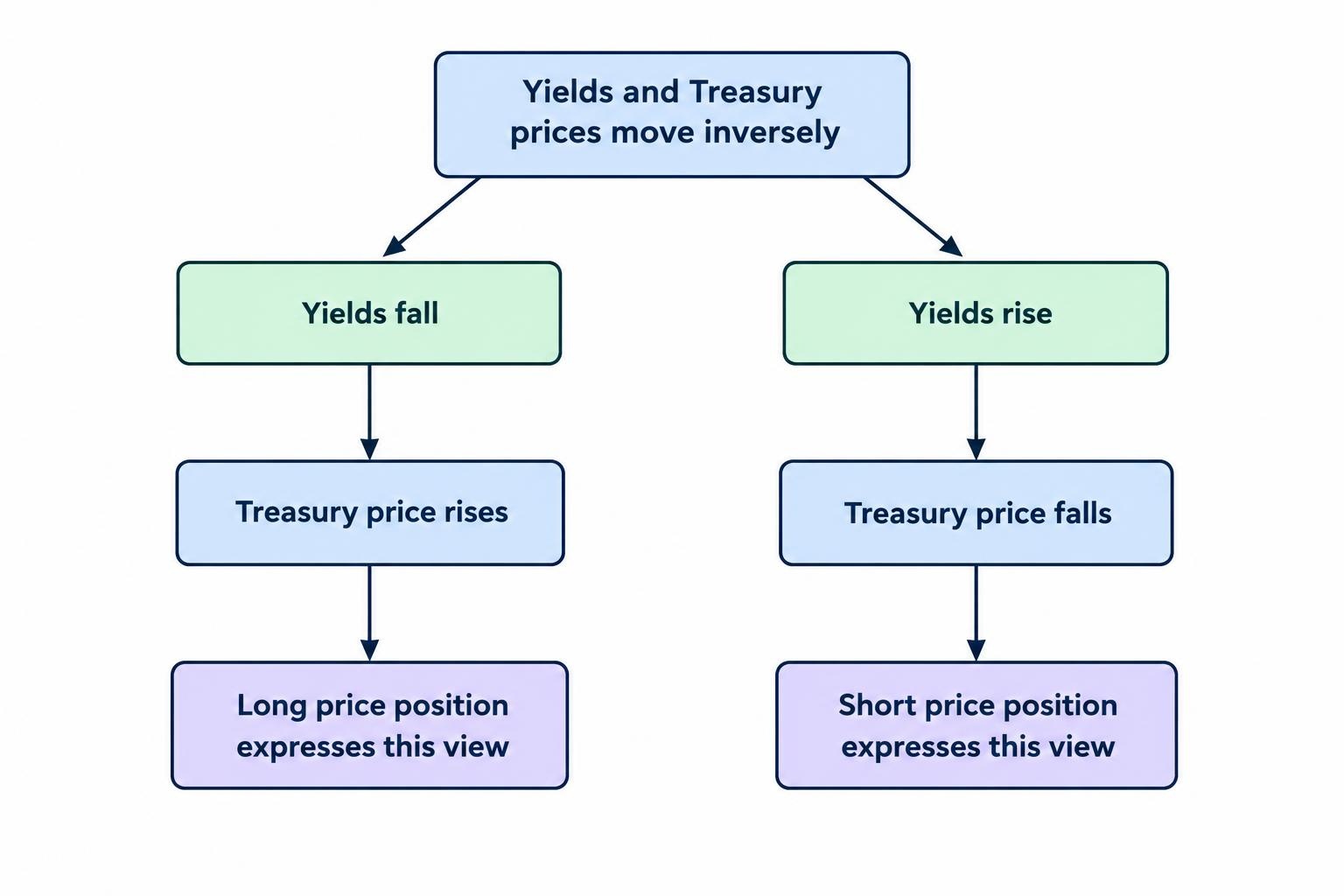
For a conventional fixed rate Treasury, price and yield move in opposite directions. A higher price means a buyer pays more for the same promised cash flows, reducing the yield available at that price. A lower price raises that yield. This relationship also means a price based spread bet and a yield based bet require different trade directions for the same market view.
If you expect yields to fall, a long position in a Treasury price market expresses that view. If you expect yields to rise, a short price position expresses it. These are directional relationships, not promises about execution or profit: your entry price, exit price and costs still decide the result.
Maturity affects the risk too. Longer dated fixed rate bonds generally have greater sensitivity to interest rate changes than otherwise similar shorter dated bonds. Coupon rates also affect that sensitivity. Both relationships are covered in the SEC investor bulletin on bond prices and interest rate risk.
That makes contract selection part of position sizing, not an administrative detail. A two year market and a long bond market are not interchangeable ways to place the same interest rate trade. Nor does a £1 stake necessarily create comparable exposure across them, especially if their point definitions differ.
A basis point is not a spread betting point
A basis point measures a change in yield: one basis point equals 0.01 percentage points. A hypothetical yield increase from 4.00% to 4.10% is therefore ten basis points.
A spread betting point measures movement under the provider’s contract definition. It might represent a decimal price increment, a fractional increment or another stated unit. There is no universal rule that a ten basis point yield move produces ten spread betting points.
Keep two questions separate: “How far could yields move?” and “What would that do to this contract’s price?” The second question needs the contract’s interest rate sensitivity. Treating the answers as identical is an efficient way to miscalculate a trade.
Reading Treasury quotes and checking point size
Treasury cash and conventional futures quotes can use whole points and fractions of a point, commonly expressed in thirty seconds. In that notation, 110-16 means 110 plus 16/32, or 110.50. It does not mean 110.16. The fractional convention and its decimal conversion are demonstrated in CME’s explanation of Treasury price calculations.
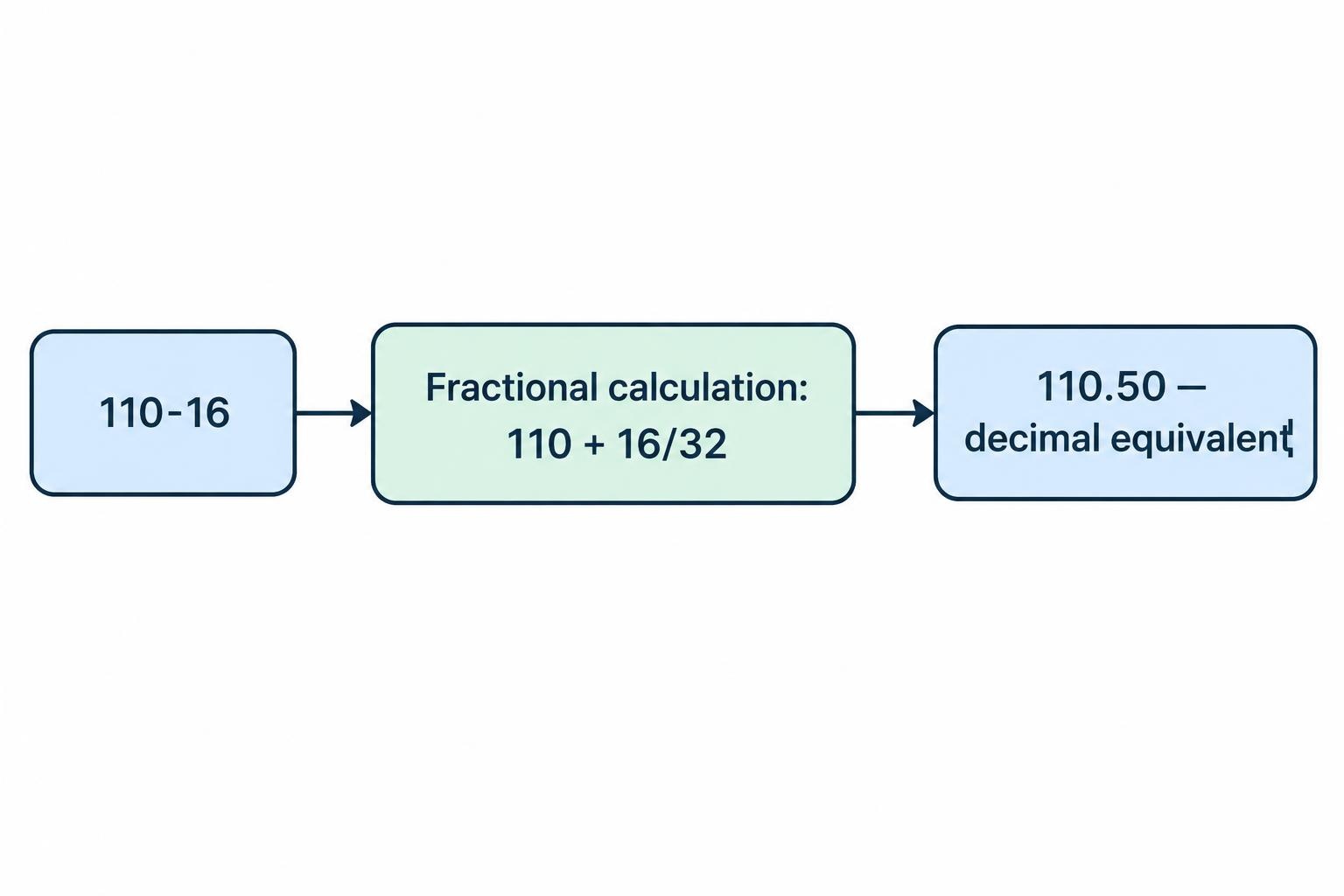
| Illustrative Treasury quote | Calculation | Decimal equivalent |
|---|---|---|
| 110-16 | 110 + 16/32 | 110.50 |
| 110-24 | 110 + 24/32 | 110.75 |
| 111-00 | 111 + 0/32 | 111.00 |
Your spread betting platform may display a converted or scaled version of the reference price. For example, a hypothetical contract could display a price of 110.50 as 11,050, with each 0.01 price movement counting as one betting point. That is an illustration, not a standard that every provider follows.
Before placing a trade, identify three separate units: the reference market’s price unit, its minimum price increment and the spread bet’s point definition. The exchange contract’s dollar tick value does not automatically become the value of a spread betting point.
Then check the cash result. If the ticket states that a one point move changes profit or loss by your chosen stake, a 25 point move at £2 per point changes it by £50 before other charges. The stake per point guide covers this calculation without relying on Treasury quoting conventions.
A useful check is to calculate the loss between your proposed entry and stop level manually. Compare that figure with the platform’s estimate. If they disagree, resolve the unit mismatch before opening the position. A misplaced decimal is not a trading strategy.
US Treasury spread betting example
Consider a hypothetical price based Treasury contract. Assume its terms define one betting point as 0.01 in the reference price, and the platform displays the scaled price. All figures below are illustrative, not current market quotes.
The opening quote is 11,049 sell / 11,051 buy. You expect the Treasury price to rise and buy at 11,051 for £2 per point.
Later, the quote reaches 11,111 sell / 11,113 buy. You close your long position by selling at 11,111. Your trading profit is:
(11,111 − 11,051) × £2 = £120.
The calculation already uses the opening buy price and closing sell price, so it already reflects the bid and ask spread. Do not subtract that spread a second time. Financing, conversion charges or other applicable fees would still need to be included.
Now consider an adverse move. If you close at a sell price of 11,011, the result becomes:
(11,011 − 11,051) × £2 = −£80.
A stop placed at 11,011 would therefore represent a planned price loss of £80 if executed exactly there. It would not automatically establish an £80 maximum loss: an ordinary stop can execute at a worse price, and other charges may apply.
The same arithmetic works for a short position, with the direction reversed. Subtract the closing buy price from the opening sell price, then multiply by the stake. The spread betting profit and loss guide covers both directions and the treatment of costs.
What moves US Treasury spread betting markets?
A useful Treasury trade starts with an explanation of what could change market pricing. “The Federal Reserve might cut rates” is incomplete. You also need to consider what traders already expect, which part of the maturity range you are trading and what could invalidate your view.
Expected interest rates and the term premium
Longer term Treasury yields reflect more than the current policy rate. They can be separated conceptually into expected future short term rates and a term premium, which compensates investors for bearing interest rate risk. Federal Reserve research also identifies Treasury issuance, balance sheet policy and economic uncertainty as potential influences on that premium; see its analysis of Treasury yield changes and term premiums.
This distinction helps explain why a forecast about the next policy decision may not translate neatly into a long bond trade. Even if your policy forecast proves correct, a change in the compensation investors demand for holding longer dated debt could work against the position.
Use that as a planning question rather than a prediction: does your trade depend mainly on a revised interest rate outlook, or on investors accepting a different return for holding longer maturities?
Inflation and employment releases
Inflation and labour market reports belong on the preparation checklist. The Bureau of Labor Statistics release calendar publishes schedules for the Consumer Price Index, Employment Situation and other releases, with times stated in US Eastern Time.
Frame any directional expectation conditionally. If an inflation surprise causes investors to price a higher future interest rate path, it could put pressure on Treasury prices. But the headline number alone does not tell you whether that repricing will happen.
Before a release, write down the result that would support your trade and the result that would challenge it. Include the possibility that the market reacts differently from your initial interpretation. A position should not depend on winning an argument with the chart.
Federal Reserve announcements and Treasury auctions
Use the Federal Reserve’s FOMC calendar and announcement archive to check meeting dates and access statements, minutes and projection materials. Treat the decision, accompanying communication and any subsequent reassessment as separate parts of your event plan.
Check debt issuance dates too. The Treasury auction schedule sets out auction patterns and notes that holidays, policy decisions and other circumstances can change them. For a position held across an auction, decide beforehand whether you intend to retain the exposure through that event.
You do not need a complicated economic model for every trade. You do need a coherent reason for choosing the maturity, direction and holding period. The guide to fundamental analysis for spread betting provides a broader framework for building that reasoning.
Trading hours and event timing
Check the provider’s dealing hours for the exact Treasury contract, not just the exchange hours of its reference market. Confirm any daily maintenance break, holiday timetable and restrictions on placing or amending orders when dealing is closed.
For a UK based trading plan, convert US event times for the actual date rather than saving a permanent clock conversion. Check your platform’s displayed time zone as well. A correctly recorded release time is little help if one calendar uses exchange time and another uses local time.
Separate “the market is open” from “these are acceptable trading conditions”. Before submitting an order, inspect the current spread and the available order controls. If your plan depends on a narrow spread or immediate execution, do not assume those conditions will persist through an announcement.
The general spread betting trading hours guide covers the distinction between reference market sessions and provider dealing windows.
Costs, financing and contract expiry
The relevant cost is the cost of holding your chosen exposure for your intended period, not just the smallest advertised spread. Review the opening spread, any holding charges, expiry treatment and the cost of replacing an expiring position.
The spread and holding costs
Translate the spread into money. Under the hypothetical contract used earlier, a two point spread at £2 per point creates a £4 difference between buying and immediately selling at unchanged quotes. That is a more useful comparison than calling a spread “tight” without checking its point definition.
If the contract has a daily holding charge, calculate its effect over the planned holding period. Check the calculation base, applicable rate, charging time and treatment of weekends or holidays. Do not assume the charge applies only to the margin you deposited.
A dated contract may reflect carrying costs through its pricing or other terms rather than an identical daily debit. Check the contract documentation rather than treating the absence of a daily fee as evidence that holding the position is free. The mechanics are covered in overnight financing costs.
Expiry and rolling the position
A Treasury security’s maturity and a spread bet’s expiry are different dates. A bet referencing a ten year Treasury market does not mean you can keep that same contract open for ten years.
For a dated bet, confirm the last dealing time, settlement reference and whether the provider closes the position or offers a rollover. Read the terms for futures and forward spread bets before choosing a contract that expires during your planned holding period.
If you move into a later contract, record the old closing price and new opening price separately. A difference between contract prices is not automatically a trading gain or loss. Include any spread or rollover charge, and check whether existing stops and limits transfer or need replacing.
Sterling stakes and currency treatment
Check the currency of the stake and settlement. In the worked example, the agreed stake is £2 per point, so the stated arithmetic produces pounds. A dollar reference market does not require you to convert the full notional value into dollars for that calculation.
Other contract arrangements may involve currency conversion. Confirm the actual terms, especially when comparing a spread bet with directly owning dollar denominated Treasuries. The two positions should not be assumed to produce the same sterling return.
Managing Treasury spread betting risk
The US government’s backing of its debt does not protect a spread betting account from market losses. Your position is a leveraged contract with a provider, not a promise that your trading capital will be repaid at maturity. “Government bond” describes the reference asset, not the safety of the stake.
Start with a cash risk budget and a defensible exit level. Suppose your plan allows a £90 price loss and the entry to stop distance is 60 betting points. The corresponding stake is £1.50 per point before allowing for charges and adverse execution. If the minimum permitted stake is larger, that contract may not fit the plan.
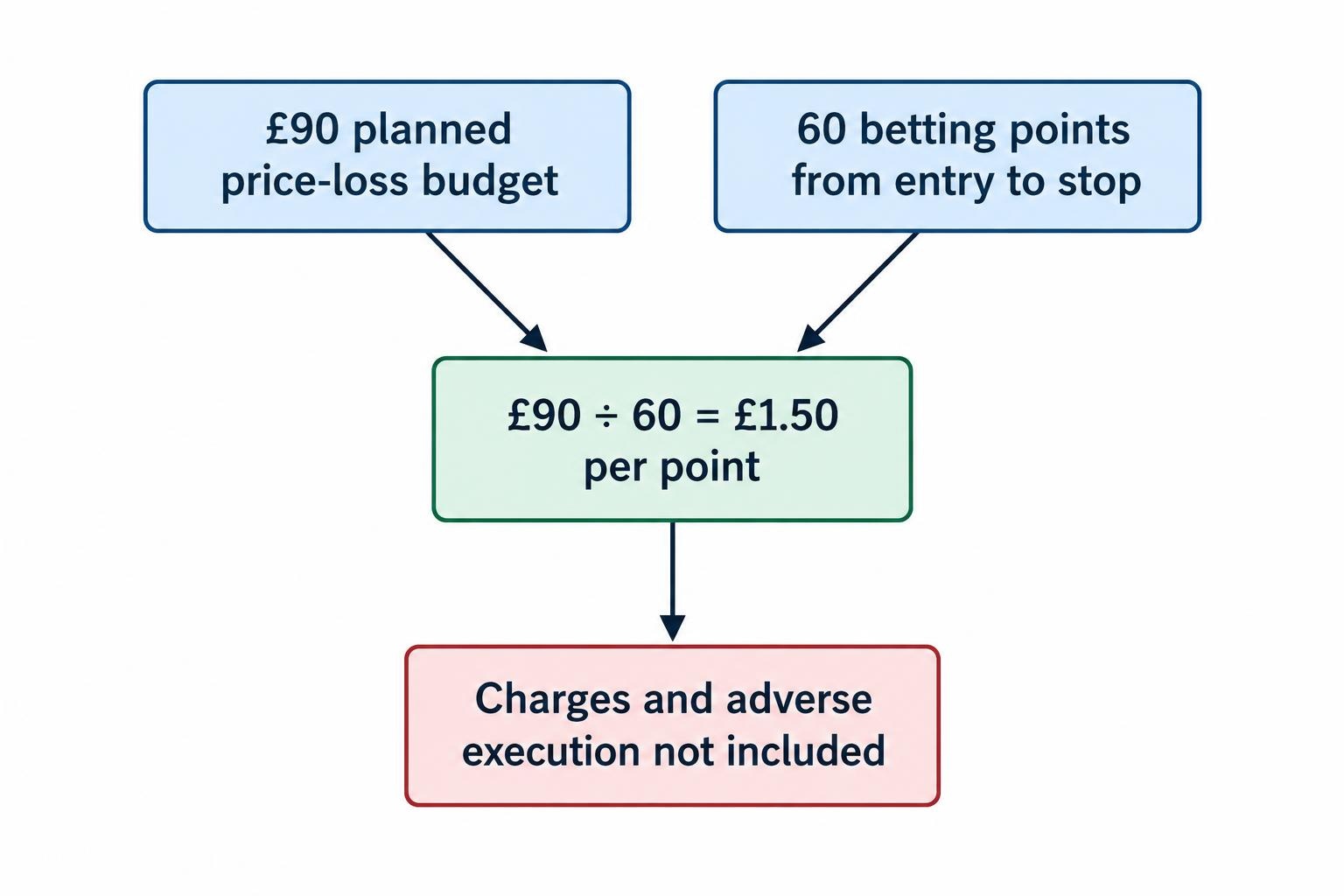
Use position sizing for spread betting to connect the exit distance with the cash exposure. Margin answers a different question: how much money the provider requires to support the position. It is not a measure of the amount you can lose on it.
For in-scope UK retail accounts, FCA rules require account level margin close out below 50% of the required margin, with positions closed as soon as market conditions allow. The rules also provide account level negative balance protection. These protections appear in FCA COBS 22.5 on retail speculative investments. They do not guarantee a planned exit price or prevent the loss of trading funds in the account.
An ordinary stop is an execution instruction, not a guaranteed loss ceiling. Check how the provider triggers it and what happens if the available price moves beyond the stop level. If guaranteed stops are offered on the chosen Treasury contract, assess their terms and premium separately. The guide to managing risk with stop losses covers these distinctions.
Also review related positions. A long Treasury price bet and another trade built around falling US interest rates may depend on the same economic outcome. Assess the combined loss scenario rather than approving each position in isolation. Adding a new market name does not necessarily add a new source of risk.
Before placing a US Treasury spread bet
A workable order plan should answer the following questions without relying on the market label alone:
- What is quoted? Identify the reference instrument, whether the quote represents price or yield, and the relevant contract month.
- What is one point worth? Confirm the point definition and calculate the cash effect of a plausible adverse move.
- Why this maturity? Match the contract to the market view rather than choosing it because its margin requirement looks affordable.
- What happens during the holding period? Check scheduled announcements, dealing breaks, financing and expiry.
- How does the trade end? Set the exit conditions, understand the order terms and leave room for costs and adverse execution.
Rehearse the arithmetic before risking money. A spread betting demo account can help you check quote scaling and order behaviour, although simulated execution cannot establish how a live order will fill.
A sound Treasury trade needs more than a view on the Federal Reserve. The direction, maturity, point value and holding terms must all express the same idea. If any of those remain unclear, the next step is to resolve the contract details, not increase the stake.