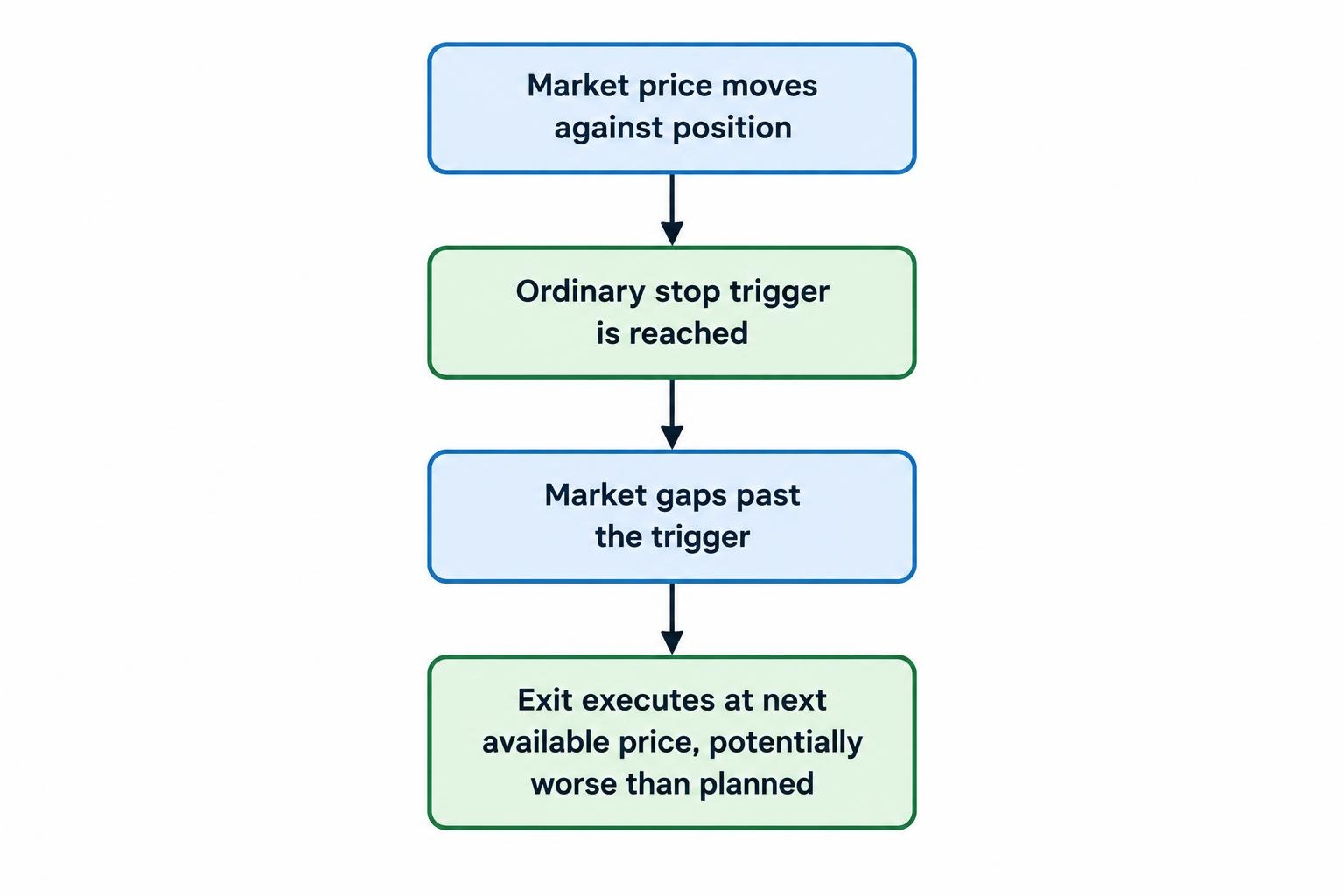
Market gap risk is the risk that a spread bet moves straight from one available price to another, passing your intended exit level without giving you a chance to close there. The result can be a loss well beyond the amount calculated from your ordinary stop loss.
The practical question is not just where you want to exit. It is where you might actually exit if prices jump. The guide to how market gaps work covers the price mechanics; this article focuses on controlling the damage to your trading account.
Why a Market Gap Can Break Your Risk Calculation
A conventional risk calculation multiplies the distance between your entry and stop by your stake per point. Buy at 8,002, place a stop at 7,962 and stake £5 per point, and the planned price loss is £200.
That calculation assumes an exit at 7,962. It does not establish that the price will be available.
When prices skip levels, an ordinary stop can execute beyond its trigger price. A shortage of liquidity can also prevent an immediate exit or produce a worse fill. These are execution risks, not simply a chart moving quickly; the ASIC guide to CFD liquidity, gapping and stop losses covers these mechanisms on pages 18 and 32.
Three amounts therefore belong in your trading plan: the intended loss at your stop, the loss under an adverse execution scenario, and the loss your account could absorb without compromising other positions. Treating those amounts as interchangeable leaves a hole in the plan.
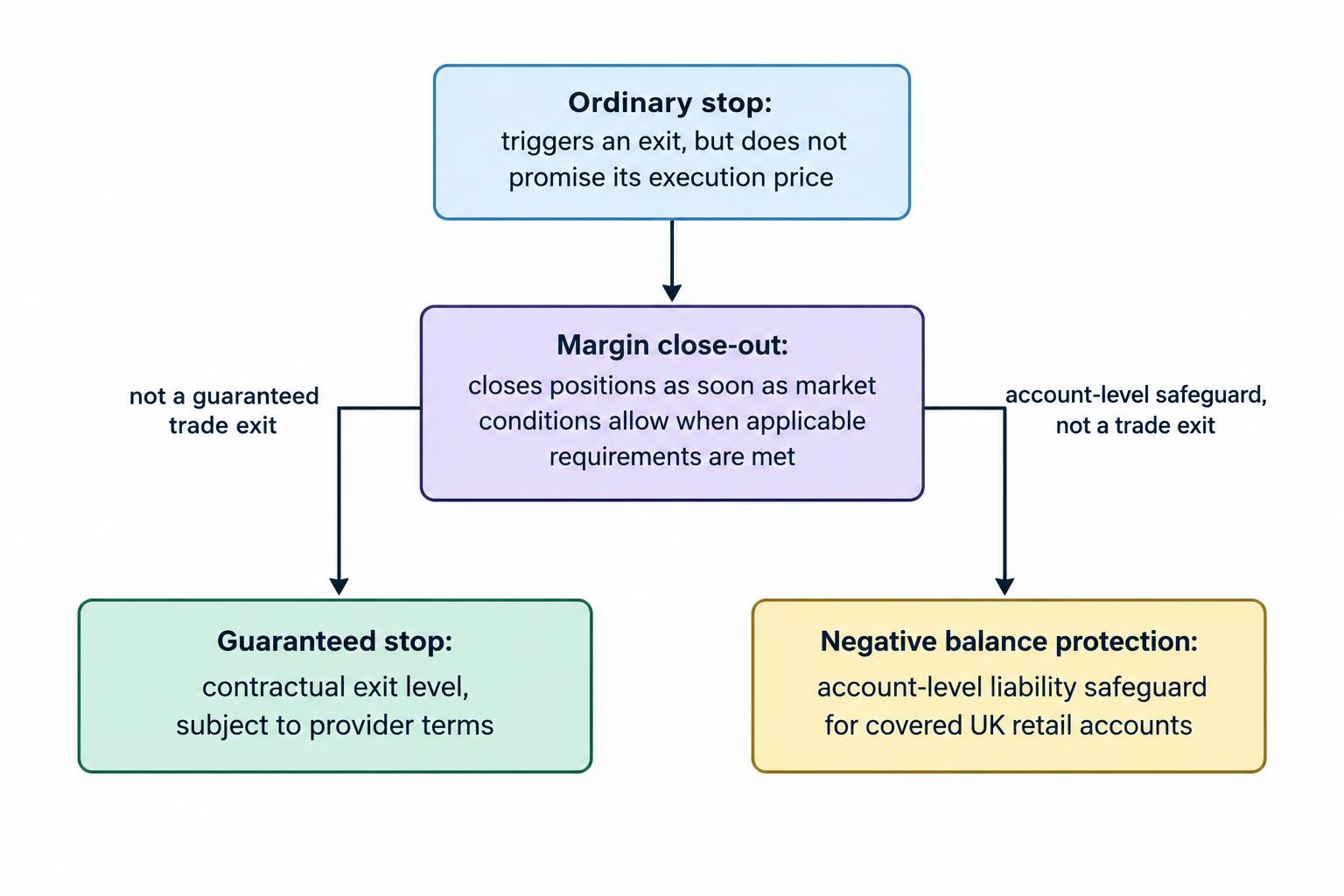
Ordinary stop-loss orders remain useful. Their purpose is to trigger an exit when the market moves against you. The mistake is treating the trigger as a contractual promise about the exit price.
Worked Example: A £200 Planned Loss Becomes £610
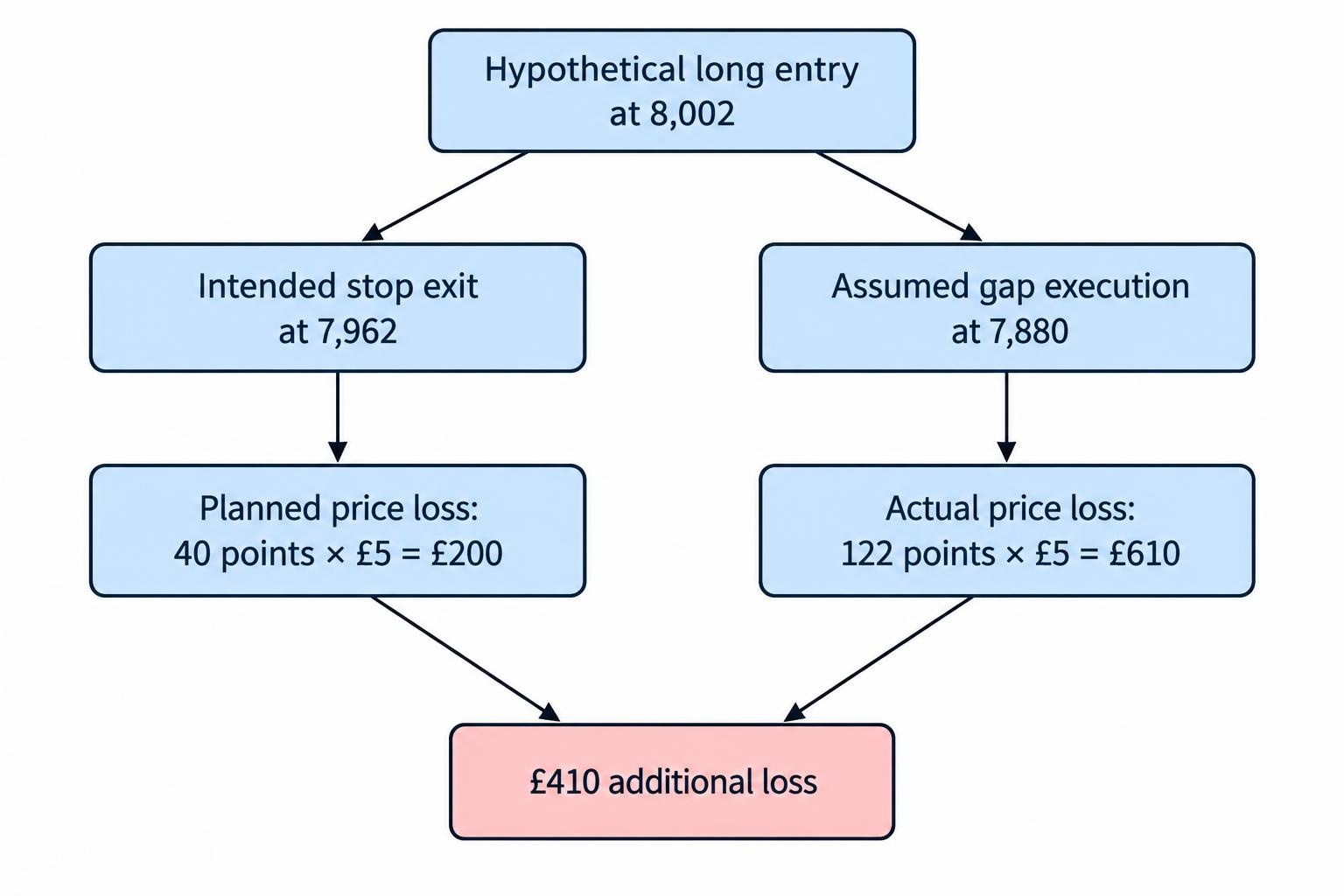
Consider a hypothetical long index spread bet held across a weekend. Assume the contract quotes one index point as one betting point, and that sufficient account equity keeps the position open until the stop executes.
| Trade detail | Price or amount |
|---|---|
| Entry quote | 8,000 sell / 8,002 buy |
| Long entry price | 8,002 |
| Stake | £5 per point |
| Ordinary stop level | 7,962 |
| Planned price loss | 40 points × £5 = £200 |
| Last available quote before the closure | 8,000 sell / 8,002 buy |
| Reopening quote | 7,880 sell / 7,886 buy |
| Assumed stop execution price | 7,880 |
| Actual price loss | 122 points × £5 = £610 |
The sell quote has fallen by 120 points between the last available quote and reopening. The trade loses 122 points because the long position opened at the buy price of 8,002 and closed at the sell price of 7,880.
The stop executes 82 points below its intended level. At £5 per point, that adds £410 to the planned loss. Any financing charges or other applicable costs sit outside this simplified calculation.
A short position has the opposite exposure: an upward gap can force the position to close at a much higher buy price. The direction changes, but the execution problem does not.
The lesson is straightforward. A stop distance measures the loss at one assumed execution price. Without a guarantee, it does not establish the maximum loss.
Where Gap Exposure Builds Up
Session Closures and Reopening Prices
A market closure creates a period during which your position remains exposed but you cannot necessarily trade the contract. Information released during that period may change the price at which trading resumes.
Check the hours of the actual spread betting contract, not just the opening hours of the underlying exchange. Establish whether the provider quotes outside the main session, whether orders operate during those hours, and whether there are maintenance breaks. The spread betting trading hours guide covers these distinctions.
An overnight position is not automatically unsuitable. It does, however, need a risk allowance that reflects periods without continuous execution. Review holding spread bets overnight before allowing an intraday trade to become an overnight commitment by accident.
Scheduled Announcements and Unexpected News
Company results, interest rate decisions and economic releases deserve a separate holding decision. Ask whether your trade is intended to capture the announcement outcome or whether it happens to be open when the announcement arrives. Those are different reasons to accept the exposure.
A calendar helps identify scheduled events. It cannot remove surprise announcements, political developments or other news that arrives without warning. A clear calendar is not a guarantee of uninterrupted prices.
Open Markets With Poor Execution Conditions
Do not confine gap planning to nights and weekends. Your risk assessment should also allow for rapid repricing during an open session, particularly around news or when executable prices are sparse.
There is also a difference between seeing a quote and being able to trade your full intended size at that quote. For planning purposes, ask what happens if the displayed price changes before execution, or if the contract temporarily cannot be traded. Watching the screen more closely does not answer either question.
Size the Position for an Adverse Exit, Not Just the Stop
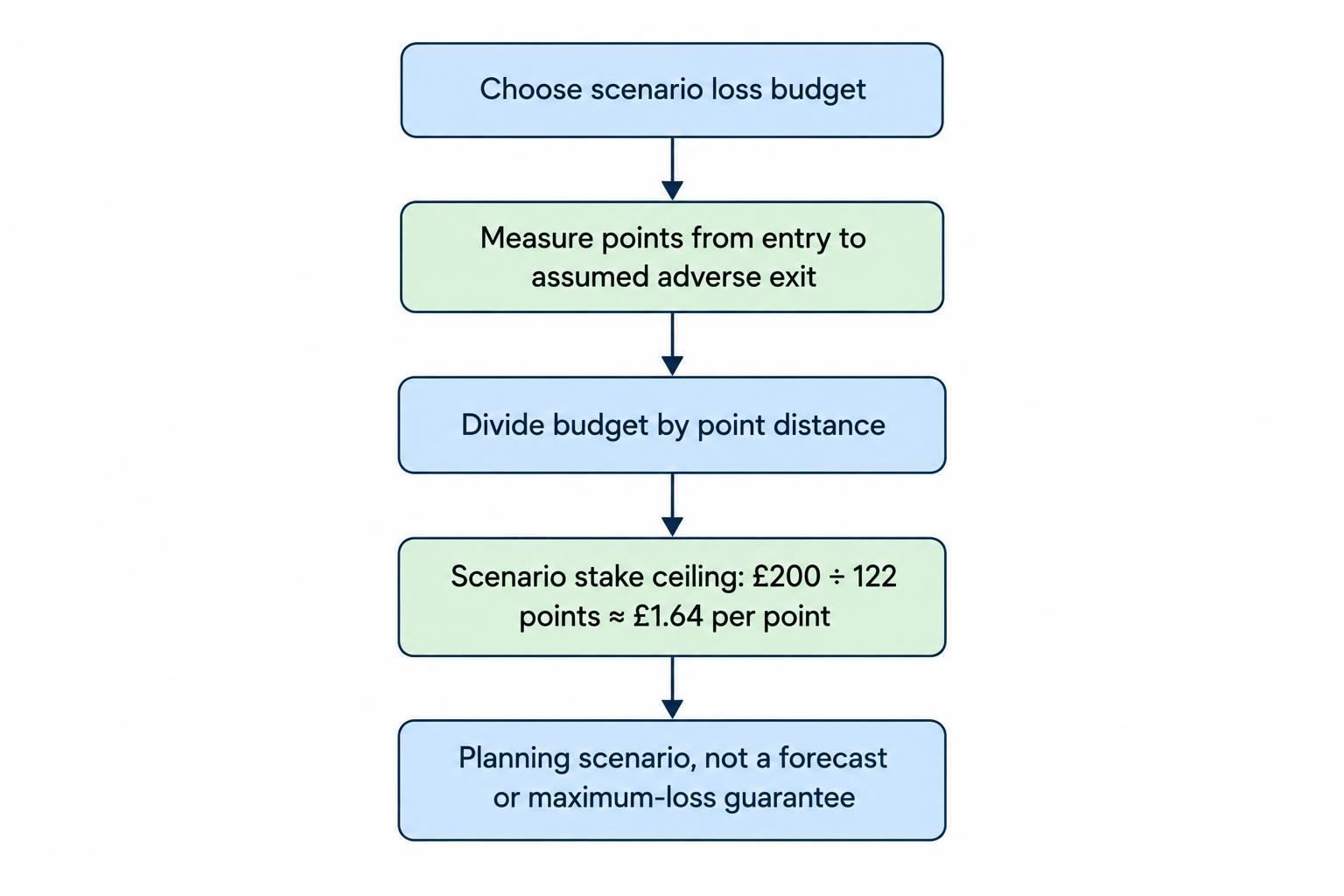
A useful stress test estimates the loss at an adverse exit price rather than assuming your ordinary stop fills exactly. This is a planning exercise, not a forecast or a maximum-loss calculation.
Scenario stake ceiling = chosen scenario loss budget ÷ distance from entry to the assumed adverse exit.
Using the earlier example, suppose £200 is the most you are prepared to lose under the chosen 122-point adverse exit scenario:
£200 ÷ 122 points = approximately £1.64 per point.
A stake of £1.60 per point would produce a £195.20 price loss at that assumed exit, before other costs. At £5 per point, the same scenario produces £610. You cannot keep both the larger stake and the smaller scenario loss simply by moving the stop closer.
Use the position sizing guide for the broader calculation. For gap exposure, the extra step is to test execution beyond the ordinary stop and decide whether the resulting loss remains acceptable.
Be precise about the distance used. If you measure directly from entry to an adverse exit, that distance already includes the move through your stop. Adding the full gap again would double count part of the loss.
Historical gaps can help you choose test scenarios, but the largest move in your sample is not a future ceiling. Test more than one outcome. If a plausible adverse exit would damage the account beyond your tolerance, reduce the stake, obtain suitable guaranteed protection, or close the position.
Choose a Control That Addresses the Actual Exposure
Reduce or Close Before the Event
Closing the position before a period of concern removes that position’s exposure to the subsequent gap once the closure has executed. Reducing the stake lowers the cash effect of each point moved, but leaves some exposure in place.
In the worked example, halving the stake to £2.50 reduces the assumed £610 loss to £305. It does not bring the loss back within the original £200 budget. Calculate the remaining exposure rather than relying on the reassurance of having “cut it in half”.
Closing also means giving up any favourable move while you are out of the market. That is a trade-off, not a failure of discipline. Re-entering later is a separate decision, with a new price and new costs.
Use a Guaranteed Stop Where Suitable
A guaranteed stop provides a contractual exit level under the provider’s terms, rather than leaving the fill exposed to ordinary stop slippage. Its value during a gap is distinct from account-level margin protection. The ESMA clarification on guaranteed stops and margin close-out also shows why a guaranteed stop does not necessarily prevent a position being closed earlier under margin rules.
Before relying on one, check that the guarantee is available for your contract, has been accepted on the position, and covers the size you hold. Check the premium, when it becomes payable, minimum distance requirements and restrictions on amendments. Do not assume a standard stop becomes guaranteed because the platform displays a projected loss.
The guide to managing risk with guaranteed stops covers their use in more detail. Include applicable premiums and other charges when assessing the trade’s total cost; the protected price loss is not necessarily the entire cash cost.
Do Not Substitute Alerts or Trailing Stops for a Guarantee
An alert asks you to act. It does not close the position. A conventional trailing stop changes the trigger as the market moves favourably, but should not be treated as guaranteed unless the contract expressly provides that protection.
Moving a stop closer may reduce the loss if it executes at the new level. It does not remove exposure to a jump past that level. Tightening the stop and increasing the stake can therefore make the gap scenario worse, even while the platform shows the same planned loss.
Margin Protection Is Not a Guaranteed Exit
For UK retail accounts covered by the relevant rules, margin close-out and negative balance protection provide different safeguards. When account net equity falls below 50% of the required margin, firms must close positions as soon as market conditions allow. Retail liability for the covered investments is restricted to funds dedicated to that trading account. These requirements appear in FCA COBS 22.5.13 and 22.5.17–19.
Neither safeguard promises execution at your ordinary stop. The phrase “as soon as market conditions allow” matters: an account can move through a close-out threshold before positions can be closed.
Negative balance protection is also an account-level safeguard, not a promise that each trade can lose only its opening margin. Money available in the account can still be lost. Do not apply UK retail assumptions to a different legal entity, jurisdiction or client classification without checking the applicable protection.
Keeping more cash in the account may provide a larger margin cushion, but it does not reduce the pounds lost per point on an unchanged position. The margin risk guide separates funding headroom from control of the underlying exposure.
Stress Test Positions Together
Assessing each bet in isolation can hide a shared exposure. Several positions may all depend on the same outcome, even when their market names differ. Three long equity indices, for example, should not automatically be treated as three independent risks.
Build a scenario across the account. Suppose three positions would lose £250, £180 and £220 under the same adverse event. The combined scenario loss is £650 before costs. The relevant question is whether the account can absorb £650, not whether each individual number looks manageable.
Portfolio correlation and spread betting risk addresses this overlap. For gap planning, test what happens when related positions move adversely together rather than assuming one will offset another.
A hedge also deserves its own execution test. Check whether both contracts are tradable during the period of concern, whether their stakes genuinely offset the intended exposure, and what happens if only one position closes. Adding an opposite trade is not the same as removing the original one.
A Short Review Before Holding Through a Closure
Before leaving a position exposed to a weekend, announcement or session break, answer these questions:
- Execution: When can this contract next be traded, and when do its orders operate?
- Protection: Is the stop ordinary or guaranteed, and has the provider accepted it?
- Cash loss: What would the position lose at the chosen adverse exit prices?
- Account exposure: What happens if related positions move against you at the same time?
- Decision: Does holding still justify the exposure, or should the stake be reduced or closed?
Write down the answers before the closure. A risk decision made while prices are available is more useful than an explanation assembled after the loss.
What to Do After a Gap
Start with the account’s actual state. Confirm which positions remain open, which orders executed, the remaining stakes and the available equity. Do not assume that a submitted instruction completed.
If exposure remains, decide whether to retain, reduce or close it using the current price and account position. Trying to recover the extra loss immediately can turn an execution problem into an oversized new trade. There is no requirement for the next position to repair the previous one.
Keep the order record, execution timestamp, relevant quotes and any platform messages if you believe the fill was inconsistent with the agreed terms. Ask the provider to explain the execution basis. A poor fill deserves examination, but the difference between a stop level and its execution price does not, by itself, establish an error.
Then revise the assumption that failed. The issue may have been the stake, the chosen holding period, misunderstood order protection or exposure repeated across several markets.
Market gap risk cannot be managed by choosing a neat stop level alone. It requires a position small enough for adverse execution, suitable contractual protection where available, or a decision not to hold the exposure. Make that choice part of your spread betting risk management plan, before the market chooses the exit price for you.