Spread betting terminology describes four things: the market being traded, the size of the position, the instructions sent to the broker and the money available to support the trade. Confusing those categories can be expensive. Margin is not the same as money at risk, a point is not always a pip, and an ordinary stop is not a guaranteed exit price.
This spread betting glossary explains the terms used on dealing tickets, charts, account statements and contract specifications. Entries are arranged alphabetically, with short examples where a definition alone leaves room for doubt. The wider spread betting learning centre covers the mechanics in longer guides.
All prices and calculations below are illustrative, not live market quotes. Platform labels and contract conventions vary, so check the definition of a point, the funding terms and the order rules for the market you intend to trade.
A
Account balance
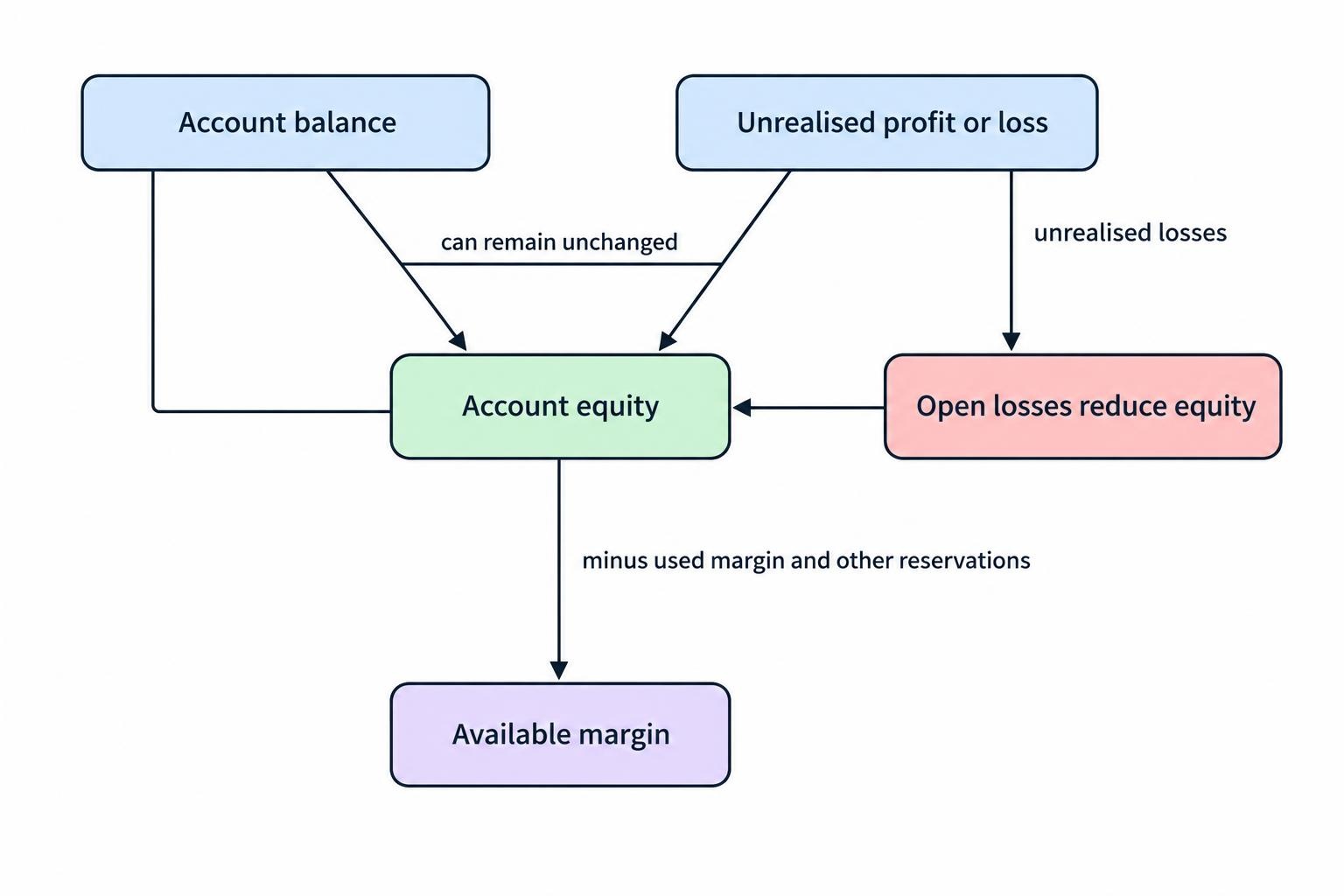
The cash balance recorded in a trading account after completed transactions, deposits, withdrawals and posted charges or adjustments. It normally excludes the running profit or loss on open positions. A £3,000 balance can therefore sit beside much lower account equity if open trades are losing money. The guide to spread betting account statements explains how these entries fit together.
Account currency
The currency in which an account records its balance and results, such as pounds sterling. This can differ from the currency of the underlying market. A sterling stake on a US index does not automatically mean the account holds dollars; check whether any charges, adjustments or transfers require currency conversion.
Account equity
The current value of the account after allowing for unrealised profits and losses, plus any adjustments included by the platform. In a simple account, equity equals balance plus running profit or loss. With a £3,000 balance and a £400 open loss, equity is £2,600. Equity, rather than the unchanged balance, shows the immediate effect of that loss.
After-hours trading
Trading outside the underlying market’s main session. A broker may quote an index or share-related market when its main exchange is closed, but those quotes can have different spreads and trading conditions. An available dealing button does not mean that the underlying exchange is open or that liquidity matches the main session.
Appropriateness assessment
An assessment of whether a customer’s knowledge and experience match the risks of a product. Questions may cover derivatives, margin, losses and previous trading activity. Passing an assessment does not establish that a trade is affordable, sensible or likely to succeed. It is an assessment of product knowledge, not a trading recommendation.
Ask price
The higher side of a two-way quote, also called the offer or buy price. You normally buy at the ask, whether opening a long position or closing a short one. In a quote of 7,998–8,000, the ask is 8,000. The lower figure is the bid, where you normally sell.
Available margin
The account equity remaining after the margin allocated to open positions and any other reservations. It is also called free margin or available funds, although platforms do not always calculate those labels identically. Available margin provides a buffer against losses; it is not automatically safe spending money. See how spread betting margin works.
B
Backwardation
A futures pricing structure in which a nearer delivery contract trades above a later delivery contract. The comparison must identify the contracts and dates involved. For spread bettors, backwardation can affect the relationship between commodity contracts and the adjustments associated with changing contract months. It is not, by itself, a forecast that prices must fall.
Base currency
The first currency in a foreign exchange pair. In GBP/USD, sterling is the base currency and the US dollar is the quote currency. A rising GBP/USD price means one pound buys more dollars. Do not confuse the pair’s base currency with the currency in which your spread betting account is maintained.
Basis
The difference between two related prices, often a cash market and a futures contract. The sign depends on the convention being used: cash minus futures and futures minus cash produce opposite answers. A futures-based spread bet can therefore move differently from a cash quote without either price necessarily being wrong.
Basis point
One hundredth of a percentage point, written as 0.01 percentage points. An interest rate rising from 4.00% to 4.25% has increased by 25 basis points. That is not a 25% increase. Basis points describe changes in rates and yields; they are not interchangeable with a broker’s betting points.
Bear market
A market characterised by a sustained decline in prices. Traders also use “bearish” to describe a negative view on a market over a stated period. A bearish opinion is not an order instruction: turning that opinion into a short spread bet still requires a stake, entry method and exit plan.
Bid price
The lower side of a two-way quote, also called the sell price. You normally sell at the bid when opening a short position or closing a long one. If the quote is 7,998–8,000, selling takes place at 7,998, subject to execution conditions and the type of order used.
Bid-ask spread
The difference between the bid and ask prices. A quote of 7,998–8,000 has a two-point spread. At £3 per point, buying and immediately selling at unchanged quotes produces a £6 loss before other charges. The spread explanation covers how this cost appears when opening and closing positions.
Break-even
The point at which a position or trading record has neither made nor lost money after the costs being measured. A trade that recovers its opening spread may still be below break-even after overnight funding. Always distinguish between price break-even, trade break-even after charges and account break-even across several trades.
Broker
The firm providing the trading account, quotes and execution arrangements. In spread betting, the contractual relationship is with the legal entity named in the account agreement, not simply the brand shown on an app. The firm’s treatment of orders, pricing and account balances forms part of that relationship.
Bull market
A market characterised by a sustained rise in prices. “Bullish” describes an expectation of higher prices, but it says nothing about the size or timing of that rise. A bullish long-term view can still sit beside a short-term falling market, which matters when a leveraged position has little room for adverse movement.
Buy
An instruction that normally opens or increases a long position, or reduces or closes a short position. The effect depends on whether the account nets opposing trades or keeps them separately. Check the dealing ticket: buying an equal stake does not always close an existing short if a separate-position setting is active.
C
Capital gains tax (CGT)
A tax category that should not be confused with the running profit shown on a trading platform. For an individual’s financial spread betting, no chargeable gains or allowable losses arise under the treatment set out in HMRC’s financial spread betting capital gains guidance. This also means a spread betting loss is not an allowable capital loss under that treatment.
Cash market
A market referring to the current value of an asset or index rather than a contract for a later expiry. On a spread betting platform, a “cash” label often distinguishes a daily funded product from a dated contract. It does not mean the trade is paid for in full or carries no financing cost.
Cash settlement
Settlement through a payment or account adjustment rather than delivery of the underlying asset. A spread bet on oil does not arrange delivery of barrels, and a share spread bet does not transfer the shares to you. The financial result comes from the contract’s price movement and its applicable adjustments.
CFD
A contract for difference: a derivative that settles changes in the price of an underlying market. CFDs and spread bets can create similar market exposure, but their contract presentation, sizing conventions and tax treatment need separate consideration. The spread betting versus CFDs comparison covers those distinctions without treating the products as identical.
Chart price
The price series displayed on a chart, which may show bid, ask, midpoint or another reference. That series is not necessarily the price used to trigger every order. A stop can appear to activate without the displayed line reaching it if the chart shows a different side of the quote.
Client money
Money held for customers, distinct from money belonging to the firm itself. When reviewing account protection, establish how the money is held and which legal entity holds it. Segregation, compensation arrangements and protection against trading losses are separate subjects. The client money guide examines the relevant account arrangements.
Close or closing
Ending all or part of an open position. A long spread bet normally closes by selling, and a short spread bet normally closes by buying. Closing fixes the trading result for the portion closed. Reducing a £5-per-point position by £2 per point leaves £3 per point exposed to later movements.
Close-out
The termination of a position, often used to describe action taken by the broker rather than a voluntary customer exit. A close-out can result from insufficient account equity or another contractual event. It is not the same as an ordinary stop-loss instruction, even though both can end a losing position.
Commission
An explicit charge for executing a trade, separate from any bid-ask spread. Whether a product has commission depends on its pricing terms. A commission-free label does not establish that trading is free: spreads, financing, premiums and other charges may still apply. Compare the complete charge structure rather than one advertised component.
Commodity
A market based on a raw material such as gold, silver, crude oil or natural gas. Commodity spread bets can reference different grades, locations and contract months. “Oil” is not a complete contract description. Check the underlying benchmark and the size of one betting point before comparing quotes or stakes.
Contango
A futures pricing structure in which a later delivery contract trades above a nearer delivery contract. It is the opposite of backwardation for that contract comparison. A higher price in the next month does not automatically create a profit when a position rolls; the roll terms determine how the price difference is handled.
Contract specification
The document or platform information defining a market’s trading terms. It can state the betting unit, minimum stake, dealing hours, expiry, margin requirement, funding method and order restrictions. Two markets with similar names can have different specifications. Read the contract description rather than assuming the chart title tells the whole story.
Corporate action
An event affecting a company’s securities, such as a share split, rights issue, merger or takeover. A share spread bet may need an adjustment to preserve the intended economic exposure. The treatment depends on the event and contract. See corporate actions and spread bets for the account effects.
Correlation
The degree to which two price series move together over a measured period. Positive correlation means they tend to move in the same direction; negative correlation means opposite directions. Relationships can change. Several positions with different names may still expose an account to the same broad market move.
Counterparty
The other party to a contract. Your spread betting counterparty is identified in the account agreement. Counterparty risk concerns whether that party can meet its obligations; market risk concerns adverse price movements. A profitable position and a financially sound counterparty are separate questions, so one does not remove the need to consider the other.
Currency conversion
Exchanging an amount from one currency into another, potentially at a rate that includes a charge or markup. Conversion may concern deposits, withdrawals, fees or adjustments. Do not assume that every bet on an overseas market requires conversion of its entire notional value; the contract and account currency determine the cash flows.
D
Daily funded bet (DFB)
A spread betting contract designed to remain open from day to day, subject to its terms, with funding handled through daily adjustments rather than a single distant expiry price. “Daily” does not mean the position must close each evening. The daily funded bets guide covers the funding and holding mechanics.
Day trading
Opening and closing positions within the same trading day rather than deliberately holding them across sessions. Closing before a funding cutoff may avoid a particular overnight charge, but it does not remove spread costs or execution risk. A platform’s definition of its trading day may differ from midnight in your location.
Dealing ticket
The order-entry panel used to set a market, direction, stake and any attached instructions. It may also display estimated margin, stop distance and potential profit or loss. Check the units beside every field. Entering “10” can mean £10 per point, ten contracts or a ten-point distance, depending on the field.
Demo account
A practice account using simulated money. It can help with platform controls, contract units and order entry, but its results do not establish how live execution or trading decisions will perform. A profitable simulation is not evidence that the same strategy will remain profitable with real funds. See spread betting demo accounts.
Deposit
Money transferred into an account. Some platforms also use “deposit” to mean the margin required for a position, which creates an avoidable ambiguity. A £1,000 account deposit and a £200 margin requirement describe different things. Neither figure, by itself, tells you the loss associated with a particular market movement.
Dividend adjustment
An account adjustment associated with a dividend affecting the underlying share or index. Under a typical cash-contract arrangement, eligible long positions receive a credit and short positions receive a debit, subject to the terms. This is not a free return separate from the price effect. See spread betting dividend adjustments.
Drawdown
A decline from a previous peak in account value or another measured performance series. A fall from £5,000 to £4,000 is a 20% drawdown. Recovering from £4,000 to £5,000 requires a 25% gain, not 20%. The drawdown management guide explains why the measurement basis matters.
E
Economic calendar
A schedule of planned releases and events, such as inflation figures, employment data and central bank decisions. Calendars can help identify times when pricing conditions may change. The published time is not a promise that the market will move, and a consensus forecast is not the same thing as the announced result.
Effective leverage
The exposure being carried relative to the account equity supporting it. An account with £2,000 equity and £20,000 of exposure has effective leverage of 10:1 on that simple measure. This differs from the maximum leverage available on a product. Portfolio calculations also need consistent treatment of gross and offsetting positions.
Entry price
The executed price at which a position begins. It can differ from the price seen when clicking the order button or from the trigger attached to a pending order. For a long position, use the actual opening buy price when calculating trading profit or loss, not the chart’s midpoint.
Equity market
A market for company ownership interests, usually shares. “Equity” has a different meaning here from account equity. A spread bet on an equity market creates price exposure under a derivative contract; it does not, by itself, make the spread bettor a shareholder with the underlying ownership rights.
Ex-dividend date
The date from which a share trades without entitlement to the declared dividend attached to the preceding entitlement period. For spread bettors, the practical issue is how the broker handles the resulting price effect and contract adjustment. The relevant adjustment can occur before the company pays cash to its shareholders.
Execution
The process of filling an order and creating, changing or closing a position. Submission, acceptance, triggering and execution are different stages. An order shown as received is not necessarily filled. The execution record should identify what traded, at which price, for what stake and at what time.
Exit price
The executed closing price for all or part of a position. A long position normally exits at the sell side of the quote, while a short normally exits at the buy side. An intended target or stop level is not the actual exit price until the relevant instruction has been executed.
Expiry
The point at which a dated contract ends under its settlement terms. Expiry can involve automatic settlement, closure or a separate rollover process. A market’s final dealing time may occur before its final settlement value becomes available. The spread betting expiry guide separates those dates and events.
Exposure
The financial sensitivity a position creates to movements in its underlying market. A £4-per-point position changes by £4 for each betting point, before separate charges and adjustments. Exposure describes the position you are carrying, not just the cash reserved as margin. It can remain large even when the margin payment looks small.
F
FCA
The Financial Conduct Authority, the UK financial conduct regulator. In account documents, an FCA reference should identify the authorised legal entity and the relevant business permissions. A familiar brand name is not enough to establish which entity holds an account, particularly where a group operates through several companies or jurisdictions.
Fill
An executed order or executed portion of an order. A complete fill satisfies the requested size; a partial fill satisfies only part of it where the order arrangements allow this. The fill price, rather than an earlier screen quote, is the price used to calculate the trading result.
Fixed spread
A spread advertised or specified to remain unchanged under stated conditions. Those conditions matter: the fixed width may apply only during certain hours, up to a certain stake or outside named events. A fixed spread does not automatically guarantee an execution price or eliminate slippage on market and ordinary stop orders.
Forex or FX
Foreign exchange: the trading of one currency against another. A currency pair expresses their relative value, so a view on GBP/USD concerns sterling against the dollar rather than sterling in isolation. With spread betting, the contract’s point convention and stake determine how changes in that quoted exchange rate affect the account.
Forward bet
A spread bet with a future settlement or expiry date. Its quote can differ from the current cash market because it reflects pricing for that later period. Funding can be reflected in the contract price rather than charged in the same way as a daily funded product. See futures and forward spread bets.
Free margin
Another common name for available margin: the equity remaining after required margin and other applicable reservations. Some platforms distinguish free margin from withdrawable cash. An amount available to support trading may not be immediately available for withdrawal, so check the account’s calculation rather than treating the labels as interchangeable.
FSCS
The Financial Services Compensation Scheme. Eligible investment claims against failed firms may receive compensation up to £85,000 per eligible person, per firm, subject to the scheme’s requirements. It does not reimburse ordinary poor investment performance. The FSCS investment protection rules explain the eligibility checks; do not assume every account or activity qualifies.
Futures contract
A contract with standardised terms for a future delivery or settlement period. A futures-based spread bet references that market but remains a separate contract with the spread betting provider. Trading the spread bet does not mean you hold the exchange-traded futures contract, even if its price provides the underlying reference.
G–H
Gap
A price movement between available quoted or traded levels without intermediate prices being available in the relevant market series. Gaps can occur between sessions or during abrupt repricing. An ordinary stop can execute beyond its trigger if no executable price is available there. The market gaps guide covers the mechanics.
Good till cancelled (GTC)
An order duration that keeps an instruction working until it is filled, cancelled or otherwise expires under the provider’s rules. The name does not guarantee indefinite life. Contract expiry, corporate events or platform policies can affect working orders, so check whether a GTC instruction has a maximum duration or other cancellation conditions.
Gross exposure
The total exposure across positions before subtracting opposing positions. A £10,000 long exposure and a £10,000 short exposure can produce £20,000 gross exposure even where simple net exposure is zero. Gross exposure helps reveal the amount of trading carried, including positions that may still incur separate funding or execution costs.
Guaranteed stop-loss order
A stop that contractually closes an eligible position at the agreed stop level, subject to the provider’s terms, rather than passing gap-related execution beyond that level to the customer. Availability, minimum distances and premiums vary by contract. The guaranteed stop-loss guide explains what the guarantee covers.
Guaranteed stop premium
The charge associated with using a guaranteed stop. The charging event depends on the provider’s terms: establish whether the premium applies when the order is placed, when it is triggered or under another arrangement. Include any payable premium when estimating the cash outcome of a stopped position.
Hedge
A position intended to offset some risk in another position or asset. A hedge can introduce its own costs and may not match the original exposure perfectly. Different underlying markets, contract dates or stake sizes create mismatch risk. The guide to hedging with spread bets covers that relationship.
High and low
The highest and lowest prices recorded during a stated period. The period and price series must be clear: a daily bid high is not necessarily the same as an ask high or an exchange’s official high. These distinctions matter when comparing chart levels with the activation of stops and other orders.
Holding period
The time between opening and closing a position. It affects which funding cutoffs, dividend events, session changes and expiry dates the trade crosses. Two trades with identical entry and exit prices can have different net results if their holding periods expose them to different charges or adjustments.
I–L
Index
A calculated measure of a group of securities or other components. An index spread bet references that measure without purchasing every constituent. Check which index version and contract the platform uses. A cash index, a futures contract and an out-of-hours broker quote can have related but different prices.
Indicative price
A price offered as a reference rather than a firm commitment to execute the requested transaction at that level. Indicative quotes can help with monitoring but should not be confused with a completed fill. Confirm the status of the quote and whether a separate dealing request is needed before execution.
Initial margin
The margin required to establish a position. It is commonly calculated from the exposure and the applicable margin rate, though contract arrangements can add other conditions. Initial margin is security for the trade, not a purchase price and not a promise that losses will stop once that amount has been used.
Intraday
Within a trading day or session. An intraday high is the highest price during that defined period; an intraday trade is opened and closed within it. Check the session boundary and time zone. A market trading across midnight can still belong to a single trading session under its contract calendar.
Last dealing time
The final time at which a dated contract can be traded before its closing or settlement process. It can differ from the official expiry time and from the underlying exchange’s closing time. Waiting for a familiar cash-market close can therefore leave a trader too late to manage the dated spread bet.
Leverage
Exposure that is larger than the money committed as margin. At 20:1, £500 of margin supports £10,000 of exposure. Gains and losses respond to the exposure, not just the £500 reserved. The spread betting leverage guide separates product leverage from the exposure actually carried in an account.
Limit order
An instruction to trade at a stated price or better. A buy limit sets the highest acceptable buying price; a sell limit sets the lowest acceptable selling price. The price restriction can leave the order unfilled. The limit order guide covers entries and profit-taking exits.
Liquidity
The ability to transact in the required size without a large adverse price effect or long delay. Liquidity concerns both price availability and size. A market can show frequent price updates but still offer poor conditions for a large transaction, particularly when underlying trading is thin or pricing changes abruptly.
Long position
A position that benefits from a rise in the relevant market price and loses from a fall, before separate charges and adjustments. A long spread bet normally opens with a buy and closes with a sell. The closing bid must exceed the opening ask for a positive price-based result.
Lot
A standardised quantity used in some trading markets and platforms. Spread bets are usually presented through a currency stake per point instead. A one-lot position elsewhere does not automatically equal a £1-per-point spread bet. Converting between them requires the underlying quantity, price unit and relevant currency values.
M
Maintenance margin
The margin required to continue supporting an existing position. Platforms may use different wording or calculations for ongoing requirements. Do not import a maintenance-margin percentage from a futures account into a spread betting account without checking the terms. Opening requirements, account warning levels and forced close-out levels are separate measures.
Margin
Money required to support a leveraged position. It is normally reserved within the account rather than treated as an execution fee. Reserving £400 does not itself create a £400 trading loss. The position’s stake and price movement determine the trading loss, while margin determines whether the account can support the exposure.
Margin call
A notification or demand that an account needs more financial support under the provider’s requirements. Possible responses include reducing positions or adding funds, but there may be little time before closure becomes necessary. Do not assume a warning guarantees a grace period. See margin calls explained.
Margin close-out
Closure of positions because account equity has fallen too far relative to the applicable margin requirement. It concerns the account’s capacity to support open trades, not whether a trading strategy still looks attractive. The calculation can involve several positions together; a profitable trade may not be insulated from an account-level problem.
Margin level
A platform measure often calculated as equity divided by used margin, multiplied by 100. With £1,500 equity and £1,000 used margin, that calculation gives 150%. Check the platform’s formula and thresholds. A percentage displayed without its definition is not enough to establish how close an account is to forced closure.
Market maker
A firm that provides buy and sell prices and is prepared to transact under its dealing terms. This describes a pricing and dealing function, not a guarantee of constant liquidity or unchanged spreads. A market-making arrangement should be assessed through the contract, execution policy and actual order terms.
Market order
An instruction to execute at the available price rather than wait for a chosen limit. It prioritises obtaining execution over controlling the exact price, subject to the provider’s handling arrangements. A displayed quote may change before the order fills. The market order guide explains the trade-off.
Market price
A general expression for a market’s current value, which needs context before it can be used in a calculation. It might mean the last traded price, current bid, ask, midpoint or official reference. For an actionable spread betting calculation, identify the price at which the position could actually open or close.
Mid-price
The arithmetic midpoint between bid and ask. With a quote of 7,998–8,000, the midpoint is 7,999. It is useful for comparison and charting, but it is not normally both your buying and selling price. Calculating results from midpoint entries and exits can hide the spread cost.
Minimum stake
The smallest stake a provider accepts for a particular contract. It can vary by market, account and position size rules. A minimum stake that looks small can still create substantial cash risk if the required stop distance is wide. Check minimum increments too; not every stake can be entered in any decimal amount.
N–O
Negative balance protection
Protection that restricts liability at the account level under its applicable rules. It is not a guarantee that each trade closes at its stop or that the account retains a positive balance. The negative balance protection guide separates this protection from ordinary stops and guaranteed stops.
Net exposure
Exposure remaining after offsetting long and short amounts using a stated method. A £12,000 long and £5,000 short in the same market produce £7,000 net long exposure on a simple value basis. Offsetting unrelated markets is less straightforward: equal monetary values do not establish that their risks cancel.
Notional value
The reference amount of underlying exposure represented by a contract, rather than its margin payment. For a simple index bet measured in whole index points, an index level of 8,000 at £2 per point represents £16,000 notional exposure. Other contracts require the correct point scaling before using a similar calculation.
Offer price
Another name for the ask or buy price. It is normally the price used to open a long position and close a short position. “Offer” does not mean a promotional deal or reduced price. On a two-way quote, it identifies one side of the market.
One-cancels-the-other order (OCO)
A linked arrangement in which execution of one instruction cancels another. A profit-taking limit and a protective stop may be linked in this way. Check the platform’s treatment of partial executions and fast markets rather than assuming that every linked-order arrangement behaves identically under all conditions.
Open position
A live trade that has not been fully closed or settled. It continues to respond to market movements and may incur funding or adjustments. An open position is different from an unfilled opening order: the position already creates exposure, while the order is an instruction that may create exposure later.
Order
An instruction to open, close or change a position under stated conditions. Its terms can include direction, size, price condition and duration. An order is not a position until execution creates the relevant exposure. Cancelled, rejected and expired orders should therefore be distinguished from completed trades when reviewing activity.
Over-the-counter (OTC)
A transaction arranged between counterparties rather than executed as the customer’s own contract on an exchange. A spread bet can reference an exchange-traded underlying while the customer’s spread betting contract remains OTC. The underlying exchange’s rules and the broker’s customer contract are related to different parts of that arrangement.
Overnight financing
A funding debit or credit applied when an eligible position remains open across the provider’s funding cutoff. The calculation can depend on exposure, reference rates, direction and an administration adjustment. A short position does not automatically earn a credit. See overnight financing costs for the calculation components.
P–Q
Pending order
An instruction waiting for its execution conditions to be met. It is also called a working order on some platforms. A pending opening order does not yet create the intended position, but it can activate later. Review old instructions after changing a trading plan; an abandoned idea can remain an active order.
Pip
A conventional unit of movement in a foreign exchange quotation. For many pairs quoted to four decimal places, one pip is 0.0001; for many yen pairs it is 0.01. Platforms may also display smaller fractions. Establish whether the spread bet’s stated point corresponds to a pip or another price increment.
Point
The price movement unit used to calculate a spread bet’s result. A point might be one index point, one penny in a share price or a stated increment in another market. There is no single point size across every contract. The contract specification, not the number of displayed decimals alone, defines it.
Point value
The cash change associated with a one-point movement. In a straightforward £3-per-point spread bet, each point changes the position’s price-based result by £3. Keep this separate from the physical size of an underlying futures contract. A small-looking quote change can represent several betting points under the contract’s scaling.
Position
The exposure created by one or more executed trades in a market. Its direction, stake, entry price and remaining size determine how it responds to price changes. An account may show trades individually or combine them into a net position, so the displayed average entry can differ from each original fill.
Position sizing
Choosing the stake or exposure for a trade. A common starting calculation divides a planned cash loss by the stop distance, while allowing separately for costs and execution uncertainty. With £100 planned risk and a 50-point distance, the starting stake is £2 per point. See position sizing for spread betting.
Price adjustment
A change to a contract price, position or account entry to reflect an event such as a dividend, corporate action or contract change. It should not automatically be treated as a trading gain or loss in isolation. Review the price movement and corresponding account entries together to understand the economic result.
Price improvement
Execution at a more favourable price than the relevant requested or reference price. A buy filled lower or a sell filled higher can represent improvement. Whether it is available depends on the instruction and execution arrangements. It is the favourable counterpart to adverse execution differences, not an extra cash payment separate from the fill.
Professional client
A regulatory client category, not simply a trader who works full time or earns a living from trading. Elective professional classification involves assessment and formal procedures, including warnings about protections that may be lost. The FCA client categorisation rules distinguish professional and retail treatment. A confident trading style does not establish eligibility.
Profit and loss (P&L)
The financial result of a position or group of positions. For a long spread bet, the price-based result is closing sell price minus opening buy price, multiplied by stake. For a short, reverse the price comparison. The profit and loss calculation guide includes costs and account adjustments.
Quote
The price or two-way prices offered for a market. A complete spread betting quote normally shows both selling and buying levels. It must be read alongside the market name, contract date and price unit. Similar-looking quotes can represent different contracts, so matching the numbers alone is not a reliable comparison.
Quote currency
The second currency in an FX pair, used to express the value of one unit of the base currency. In EUR/USD, the dollar is the quote currency. This naming convention describes the exchange rate. It does not automatically determine the currency stake or cash settlement arrangements of a spread bet.
R
Realised profit or loss
A result fixed by closing or settling all or part of a position. It differs from unrealised P&L, which continues to change while exposure remains open. A realised trading gain may still differ from the final net result after financing, premiums and other charges are included in the accounting.
Reference rate
A benchmark used as an input to a pricing or funding calculation. The customer’s actual funding rate may include an addition, subtraction or other contractual adjustment. Knowing the benchmark alone is therefore not enough to calculate the charge. Check the benchmark, applicable date, annualisation method and provider adjustment together.
Requote
A replacement price offered when the original requested price is no longer available under the dealing arrangement. Depending on the system, the customer may need to accept the new quote. This differs from an order already filled with slippage. Check the order status rather than assuming a changed quote means execution occurred.
Resistance
A price area where selling interest has previously slowed or reversed an advance, or where traders expect that pressure. It is an analytical reference, not a barrier that the market must respect. A sell order placed near resistance still needs its own risk limit if the price continues higher.
Retail client
The client category distinct from professional-client and eligible-counterparty treatment. It is not a synonym for inexperienced trader: an experienced individual can remain a retail client. Read the account’s classification notice rather than inferring status from account size, trading frequency or the presence of advanced tools on the platform.
Risk per trade
The loss allocated or estimated for one position under stated assumptions. It is often expressed as a cash amount or percentage of equity. An ordinary stop makes this a planned figure rather than a guaranteed maximum. Separate the intended stop-based loss from a stress estimate that allows for gaps and additional charges.
Risk-reward ratio
A comparison between the loss planned for a trade and its intended profit target. Risking £100 to target £200 gives risk-to-reward of 1:2. Some traders quote the inverse, so state the convention. The risk-reward ratio guide explains why the ratio cannot establish profitability without other information.
Rollover
Continuing exposure beyond a contract boundary, commonly by closing an expiring contract and opening a later one. The new contract can have a different price and spread. A rollover does not erase the result on the old position. Check whether the process is automatic, optional or unavailable for the contract.
S
Sell
An instruction that normally opens or increases a short position, or reduces or closes a long position. Its effect depends on the account’s netting and position-handling settings. When closing a long, confirm that the ticket is reducing the existing exposure rather than creating a separately recorded short trade.
Settlement price
The value used to calculate a contract’s final result under its settlement rules. It can be based on an official calculation, auction or other stated reference rather than the last price visible on a chart. A trader holding through expiry needs the settlement method, not just an estimate of the final quote.
Short position
A position that benefits from a fall in the relevant market price and loses from a rise, before costs and adjustments. A short spread bet normally opens by selling and closes by buying. You do not need to own the underlying asset to open that derivative position.
Slippage
The difference between the expected or requested execution price and the actual fill price, using a clear comparison point. Slippage can be favourable or adverse. It is not the same as the quoted spread, although both affect results. The slippage guide covers market orders, stops and fast-moving prices.
SONIA
The Sterling Overnight Index Average, a sterling interest-rate benchmark administered by the Bank of England. It reflects eligible overnight borrowing transactions between financial institutions and other institutional investors. The Bank of England’s SONIA benchmark information describes its basis. A broker’s contractual funding charge should not be assumed to equal the published benchmark alone.
Spot
A label referring to a current-market price rather than a dated futures price, although product conventions differ. A spread betting contract labelled “spot” is still a derivative contract with its own funding and dealing terms. It does not mean that the customer receives immediate ownership or delivery of the underlying asset.
Spread
The gap between the buying and selling prices quoted for a contract. The cash effect depends on both its width and the stake. A two-point spread at £10 per point represents more cash than a five-point spread at £1 per point. Compare equivalent exposure and the same trading conditions.
Spread betting
A derivative arrangement in which the financial result depends on movement in a referenced market and the agreed stake per point. Positions can be taken on rising or falling prices without purchasing the underlying asset. Because losses respond to the full position, the amount reserved as margin can understate the exposure being carried.
Stake per point
The cash amount gained or lost for each betting point moved by the contract. At £2 per point, a favourable 25-point movement produces £50 before separate charges. The stake per point guide explains the relationship between the stake, price unit and position size across markets.
Stop-entry order
An instruction intended to open a position after the market reaches a trigger beyond the current price in the chosen direction. A buy stop is normally placed above the current market and a sell stop below it. Once triggered, execution follows the order’s terms; the trigger is not automatically a guaranteed fill price.
Stop-limit order
An order combining a stop trigger with a limit price. Reaching the trigger activates the limit instruction, which restricts the acceptable execution price. This provides price control but creates a risk of no fill. In a fast move, the market may pass through the allowed range and leave the order unexecuted.
Stop-loss order
An instruction intended to close a position after an adverse price movement reaches a trigger. An ordinary stop does not guarantee execution at that trigger. A sell stop protects a long position; a buy stop protects a short. The stop-loss order guide covers these mechanics.
Support
A price area where buying interest has previously slowed or reversed a decline, or where traders expect it to appear. Support is an analytical area rather than an enforceable floor. A long spread bet opened near support can still lose if the market breaks below it or gaps through the planned exit.
Swap
A term that can mean different things depending on context. In finance, a swap is a contract exchanging cash flows; on some trading platforms, “swap” is used as a label for overnight funding. Do not assume a platform’s swap entry means the customer has entered a separate wholesale swap contract.
T
Take-profit order
An instruction intended to close a position at a favourable target, commonly using a limit order. A long position normally uses a sell limit above the market; a short uses a buy limit below it. A profit target is not a prediction, and its execution conditions still depend on the order arrangement.
Tax treatment
The rules determining whether a transaction creates taxable income, gains or deductible losses. Spread betting should not be described as tax-free in every possible circumstance. Wins arising from carrying on a trade can require different treatment, with the contract and economic substance relevant under HMRC’s spread betting income guidance. Company and non-UK situations need their own assessment.
Technical analysis
Analysis of market data, commonly price and sometimes volume, to assess patterns, trends or trading conditions. It includes chart levels and calculated indicators. A chart-based signal does not determine stake size, guarantee execution or remove the need for a loss limit. Those are separate parts of the trading decision.
Tick
A price increment or recorded price update, depending on context. A contract’s minimum tick size may differ from its betting-point size. If a minimum tick is 0.25 index points and the stake is £4 per full index point, one tick changes the price-based result by £1.
Time in force
The duration or execution condition attached to an order. Examples include a day order or good till cancelled instruction, where offered. Time in force answers how long or under what timing conditions the order remains active. It does not replace the order’s price condition, stake or direction.
Total trading cost
The combined effect of the charges and execution differences relevant to a trade. Depending on the contract, these can include spread, commission, funding, premiums and currency conversion. Avoid counting the spread twice: a profit calculation using actual opening and closing prices already reflects the bid-ask prices used for those executions.
Trading hours
The periods during which the provider accepts trades in a contract. These can differ from the underlying market’s main exchange hours and can change around holidays. Funding cutoffs and last dealing times are separate timestamps. The spread betting trading hours guide explains which schedules to check.
Trailing stop
A stop whose trigger moves with favourable price changes under a defined trailing rule, while not moving back simply because the market reverses. The trailing distance and update method determine its behaviour. An ordinary trailing stop remains exposed to slippage. See trailing stops explained for the mechanics.
Trigger price
The price condition that activates an order. It must be read with the trigger side: bid, ask or another stated reference. Triggering and filling are different events. A stop set at 8,000 may activate there but execute elsewhere if it becomes a market-style instruction and the available price changes.
U–Z
Underlying market
The asset, index, currency pair, rate or other reference from which a derivative takes its value. The underlying helps explain the contract’s price, but the spread bet also has its own spread, funding and settlement terms. Owning the derivative is not the same as owning the underlying asset.
Unrealised profit or loss
The running result on an open position, also called floating or running P&L. It changes with the relevant valuation price and becomes realised when exposure is closed or settled. A displayed unrealised profit is not a completed gain, and a displayed unrealised loss can still affect the account’s ability to support positions.
Used margin
The amount allocated to support existing positions under the platform’s margin calculations. It normally reduces the funds available to support further exposure. Used margin is not an accumulated trading fee. Closing a position can release its margin, but any realised loss reduces the account balance separately.
Variable spread
A spread whose width can change rather than remain at one stated value. The width available at a quiet moment may differ from that during a release, session change or thin trading period. Measure the actual contract at the intended trading time rather than treating a minimum advertised spread as a constant.
Volatility
The extent of price movement over a measured period. Higher volatility means larger fluctuations on the chosen measure, not a reliable direction of travel. A stake suitable for a quiet market can produce larger cash swings when movement expands. The volatility and trading risk guide covers the sizing implications.
Volume
The amount traded in a market over a period, using a stated unit. A spread betting chart may display underlying exchange volume, tick activity or another series rather than a consolidated measure of all trading. Check what the data represents before interpreting a high or low reading.
Whipsaw
A rapid move followed by a reversal that can catch traders positioned in either direction. The term often describes a breakout that fails soon after entry or repeated stop-outs in a choppy market. It describes price behaviour, not an execution error, and does not prove that the original order was handled incorrectly.
Win rate
The percentage of measured trades that finish as winners under a stated definition. A high win rate can coexist with losses if losing trades are larger than winners or costs absorb the gains. Decide whether a “winner” means positive price P&L or a positive result after every relevant charge.
Yield
A return measure commonly associated with bonds and income-producing assets. Bond prices and yields have an inverse relationship under otherwise unchanged terms. For a spread bet, establish whether the quoted contract references a bond price or a yield measure. A bullish view on yields is not the same as a bullish view on bond prices.
Zero commission
A pricing description meaning no separately stated execution commission applies under the advertised terms. It says nothing by itself about spread width, overnight funding or other charges. Zero commission and zero cost are different claims. Evaluate the contract’s complete pricing rather than treating the absence of one fee as the absence of all fees.
UK retail protection terms in context
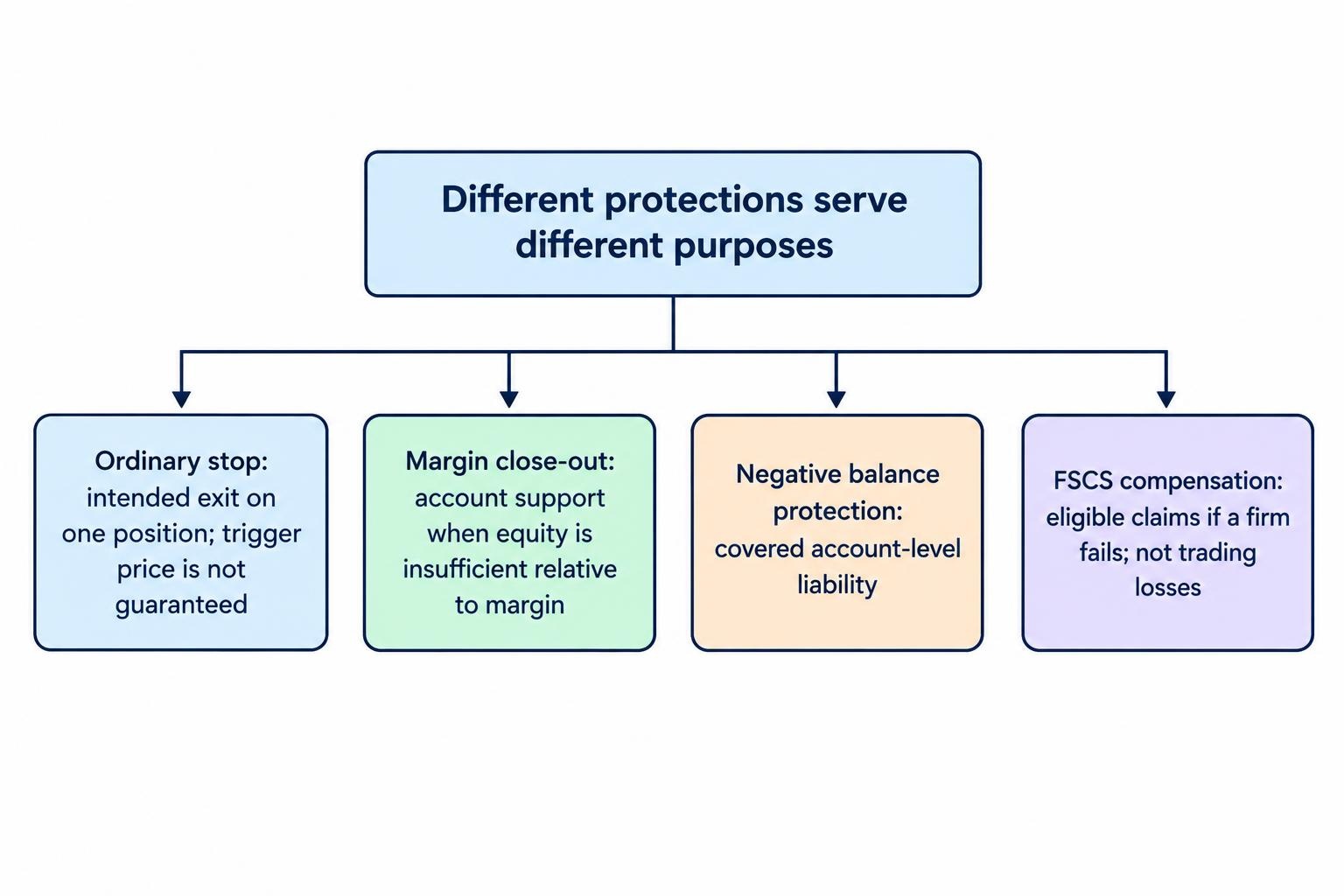
For UK retail accounts within the relevant rules, opening margin requirements, margin close-out and negative balance protection perform different jobs. Margin requirements constrain opening exposure. Where net equity falls below 50% of the required margin, positions must be closed as soon as market conditions allow. Negative balance protection restricts liability for the covered speculative investments to funds in the account. These are distinct requirements under FCA COBS 22.5 retail derivative protections, not three names for a guaranteed stop.
That distinction matters when estimating a loss. An ordinary stop addresses an intended exit on one position. Margin close-out addresses account support. Negative balance protection addresses account-level liability. FSCS compensation concerns eligible claims when a firm fails, not reimbursement for a trading plan that went wrong.
Reading a dealing ticket with the glossary
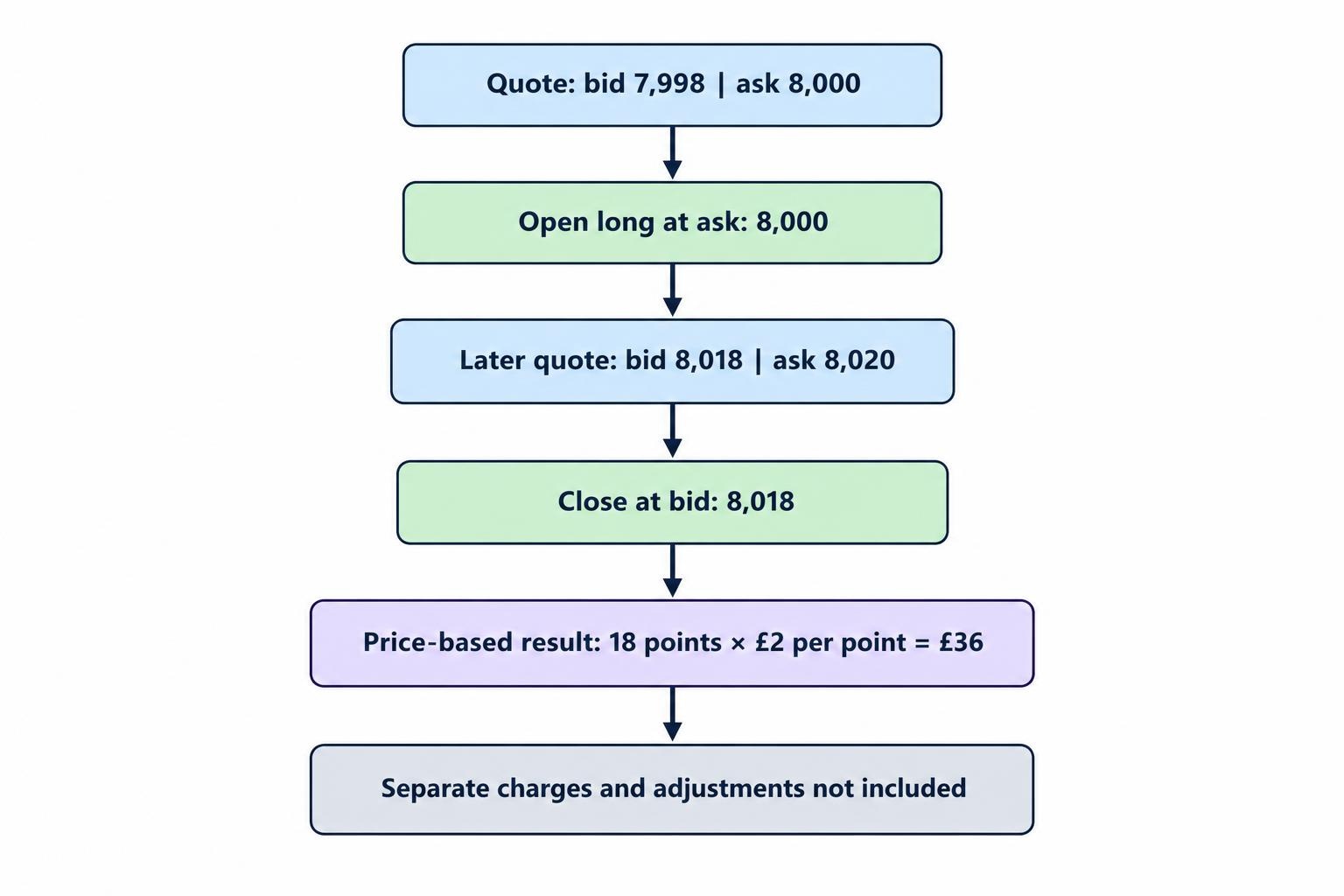
Suppose an illustrative index quote is 7,998–8,000 and you buy at £2 per point. Your opening price is the ask of 8,000. If the later quote is 8,018–8,020, closing the long means selling at the bid of 8,018. The price-based profit is 18 points multiplied by £2, or £36, before separate charges and adjustments.
The margin shown on the ticket is the amount required to support that exposure, not the position’s maximum loss. An ordinary stop 40 points below the executed entry represents an intended £80 price-based loss, but the final result can differ because of execution and costs. A guaranteed stop needs its own contractual terms and any premium included in the estimate.
Read the fields in that order: contract, point size, direction, stake, execution price, margin and exit instructions. The spread betting worked example follows a complete trade through those calculations.