Overnight financing is the charge, or sometimes credit, applied when a spread bet remains open beyond its funding cut-off. For a daily funded position, it can turn a modest trading expense into a substantial holding cost. The amount depends on your exposure, the funding rate, trade direction and number of chargeable days.
The most expensive mistake is calculating interest on the margin deposit rather than the value of the position. A £1,000 deposit might support a much larger exposure, and the financing calculation can follow that larger figure.
This guide covers how overnight financing costs work, how to estimate them and how to compare contracts without confusing a low dealing spread with a low total cost. Financing is one part of the wider spread betting cost structure, rather than a substitute for checking execution charges and other adjustments.
What overnight financing pays for
A cash spread bet gives you exposure to an asset without paying its full purchase price. Overnight financing is the contractual cost of maintaining that exposure beyond the provider’s funding cut-off. You may see it labelled funding, holding interest, an overnight adjustment or, particularly in forex, a swap.
It is not a repayment towards ownership of the underlying asset. Nor does the charge necessarily equal an identifiable bank loan taken out for your individual trade. What you pay follows the provider’s contract terms, including its reference rate, markup and calculation method.
The distinction matters most with daily funded bets. Their running funding adjustments make the holding period part of the cost calculation. A trade planned for two sessions can become much more expensive if it turns into a six-week wait for the market to recover.
Keep funding separate from the dealing spread. The spread affects the prices at which you enter and exit; financing relates to maintaining the position across chargeable cut-offs. Paying one does not remove the other.
How overnight financing is calculated
For a cash index or share spread bet priced using an annual funding rate, the following model provides a useful estimate:
Financing charge = notional exposure × annual funding rate × chargeable days ÷ annual day-count divisor
Use the rate as a decimal: 8.5% becomes 0.085. The day-count divisor and exposure valuation must come from the contract terms. Forex swaps and futures-related adjustments may need a different calculation.
Start with notional exposure, not the deposit
Notional exposure is the value represented by the position. The FCA’s findings on CFD and spread betting funding charges identify financing charged on total notional value, rather than just the initial margin, and highlight differences in funding charges between firms and underlying assets.
For an index bet where one point means one whole index point, the calculation is straightforward:
Notional exposure = index level × stake per point
An index level of 8,000 and a stake of £2 per point represent £16,000 of exposure. If the assumed initial margin is 5%, the deposit requirement is £800. That does not make £800 the funding base.
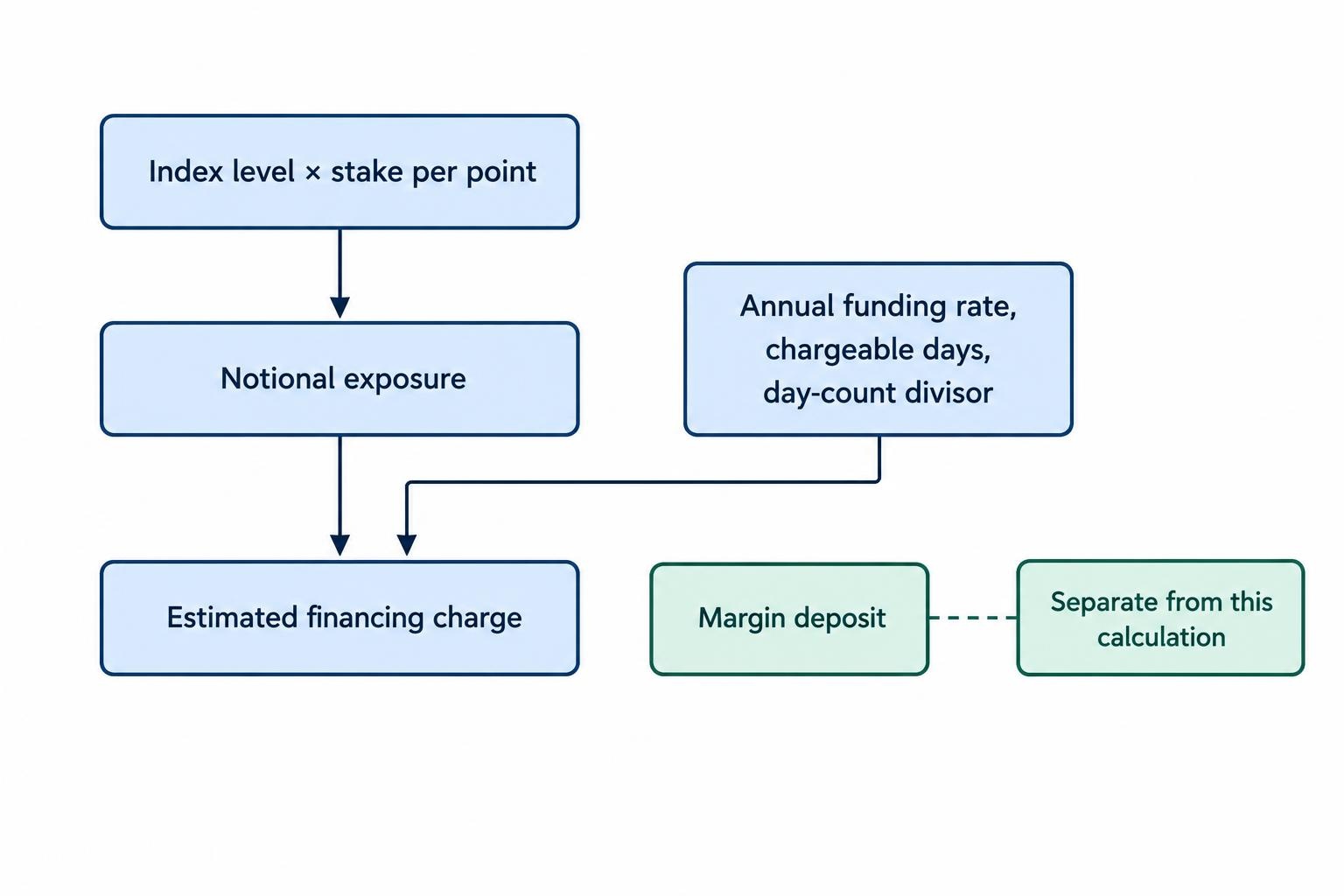
The distinction between exposure and the cash reserved to support it is covered in the guide to spread betting margin. The deposit also does not cap the position’s possible trading loss.
Check the point scale before applying any formula. An index point, a share-price penny and a forex pip are not interchangeable. The platform’s stake per point convention determines how the quoted price translates into exposure.
Identify the reference rate and provider markup
A funding schedule may quote a reference interest rate plus or minus an administration markup. Keep those components separate when comparing offers. A competitive reference rate is little help if the added markup cancels the saving.
For sterling contracts that reference SONIA, the benchmark measures overnight sterling wholesale borrowing rates using actual transactions. The Bank of England’s SONIA benchmark description sets out what that rate represents. SONIA is not itself a retail spread betting funding quote.
Suppose a hypothetical contract uses a reference rate of 4.5% plus a markup of four percentage points for long positions. Its annual long funding rate would be 8.5%. These figures are illustrative, not current market rates or an advertised provider tariff.
Do not infer the benchmark solely from the currency shown beside your stake. Confirm the reference rate used for that instrument and whether any conversion applies to the resulting adjustment.
Check the divisor and valuation method
Use the published annual day-count divisor rather than automatically dividing by 365. On £16,000 of exposure at 8.5%, a 365-day divisor produces approximately £3.73 per chargeable day. A 360-day divisor produces approximately £3.78.
Also establish which price determines the funding base. If the contract uses each day’s valuation, the charge can change as the market moves, even if your stake and annual rate stay unchanged. If you increase or reduce the position, calculate funding for the exposure present at each relevant cut-off.
A single daily estimate is useful for planning. Reproducing an actual statement requires the historical exposure, applicable rates and day multipliers for every posting.
Worked example: holding a £2-per-point index bet
Assume a long cash index position with the following terms: an index level of 8,000, a £2 stake per whole index point, an annual funding rate of 8.5% and a 365-day divisor. Assume the exposure and rate remain unchanged throughout the holding period.
The notional exposure is £16,000, so one chargeable day costs:
£16,000 × 0.085 ÷ 365 = £3.7260, or approximately £3.73
| Chargeable days | Financing cost | Equivalent index points at £2 per point |
|---|---|---|
| 1 | £3.73 | 1.86 |
| 3 | £11.18 | 5.59 |
| 7 | £26.08 | 13.04 |
| 30 | £111.78 | 55.89 |
| 90 | £335.34 | 167.67 |
The totals use the unrounded daily amount. Actual postings can differ slightly if the provider rounds each adjustment separately.
After 30 chargeable days, the position needs approximately 55.89 favourable index points just to cover financing. That is before allowing for any other costs not already reflected in the execution prices.
If the assumed margin deposit was £800, the £111.78 funding bill would equal about 14% of that deposit. It would still represent only about 0.70% of the £16,000 exposure. Both percentages describe the same charge; the denominator changes the impression.
This is why an apparently small annual funding percentage can have a large effect on the cash committed to a leveraged position. The daily charge looks small, the holding period is what changes the bill.
When financing applies: cut-offs, weekends and holidays
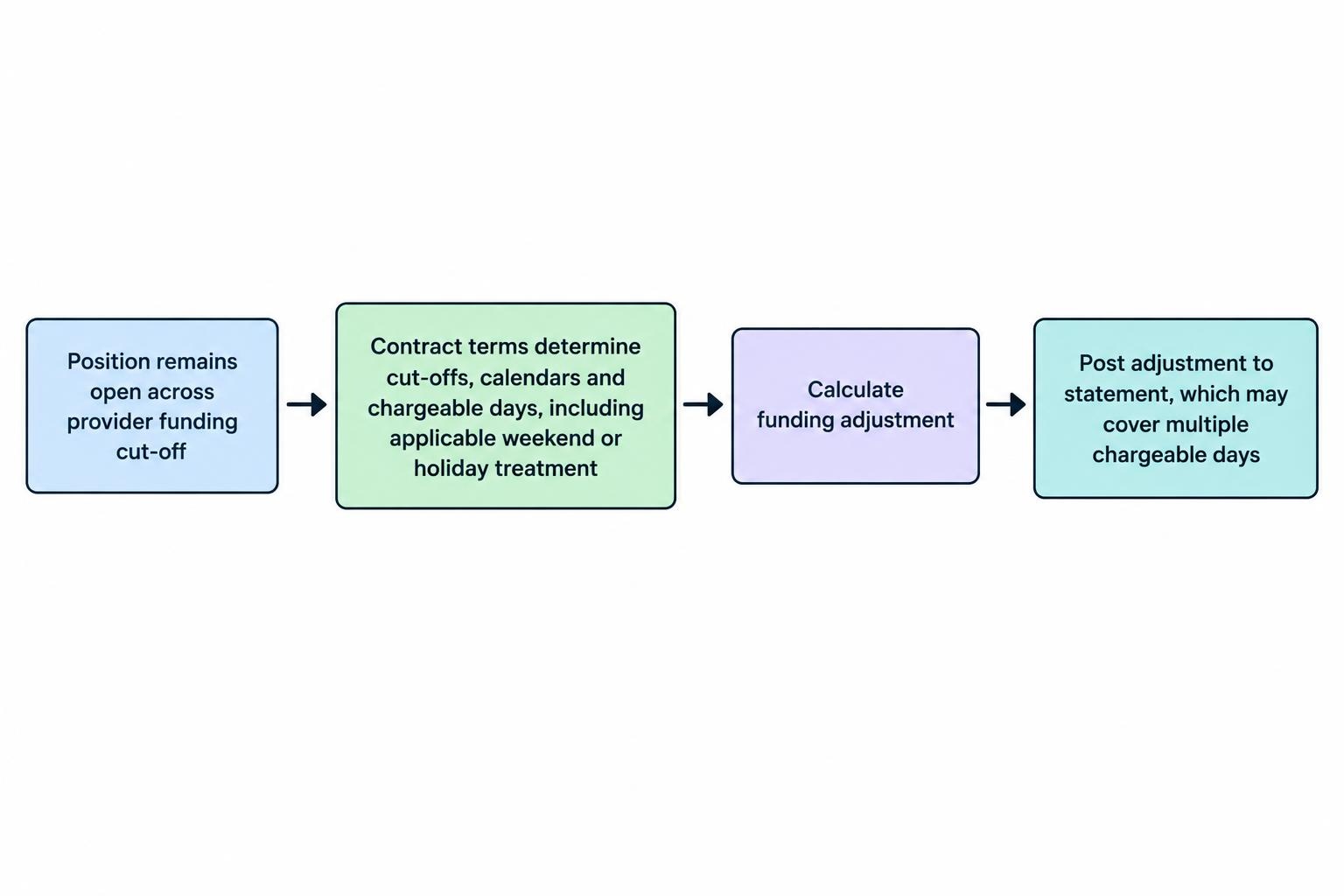
For a contract that charges funding at a daily snapshot, crossing the cut-off matters more than holding the position for a full 24 hours. A trade opened shortly before that snapshot may attract a charge even though it has been open for only a short time.
Check the cut-off for the instrument, its stated time zone and how daylight saving affects the displayed time. Do not assume that the cash exchange’s closing bell, midnight on your phone and the provider’s funding cut-off are the same event.
The guide to spread betting trading hours covers market availability. For financing, you also need the contract’s separate charging timetable. Being able to trade a market does not establish when its funding adjustment occurs.
Count chargeable calendar days
A weekend does not automatically create a funding holiday. Check how the contract accounts for non-business days: adjustments may be posted separately or grouped into a larger charge at one cut-off.
Using the worked example, a posting that covers three chargeable days would be approximately £11.18, not £3.73. A larger debit does not necessarily mean the annual rate has tripled; it may mean the posting covers three days.
Do not apply a universal “triple funding day” across all instruments. For forex, check the pair’s funding calendar and relevant holidays. For other markets, check the provider’s weekend and holiday schedule rather than borrowing a rule from a different product.
Distinguish the date the adjustment appears on the statement from the period it covers. That small administrative detail can explain an otherwise puzzling debit.
Why long and short funding can differ
A short position does not automatically earn interest. Under a simplified schedule, a provider might calculate long funding as the reference rate plus its markup, while short funding starts with the reference rate less its markup. The actual schedule may use different rates or conventions.
Consider a hypothetical short funding formula of reference rate minus markup. A 4.5% reference rate less a 3% markup would produce a 1.5% annual credit before other charges. A 2% reference rate less the same markup would instead produce a 1% annual debit.
That example illustrates the arithmetic, not a promise that a given short trade will receive a credit. Read the published buy and sell rates, including the meaning of positive and negative signs. A platform’s “negative swap” can be easy to misread if you assume the sign convention.
Share borrowing is a separate check
For a short share bet, establish whether a stock borrowing charge applies and whether it sits inside or outside the displayed funding rate. Ask whether the borrow rate can change while the position is open.
Do not treat a favourable interest adjustment as the final holding cost until borrowing and other adjustments have been checked. The guide to share spread betting costs covers the wider share-related charges.
Dividend adjustments also need separate treatment. They are not simply another name for overnight interest, even when both appear as cash entries against the same position.
Opposing positions may still incur funding
Opening an equal short position against a long position does not necessarily stop the funding bill. Both contracts can remain open and attract separate charges. The FCA’s November 2025 review announcement highlighted overnight funding charged separately on matched long and short positions, with potentially substantial ongoing costs and little consumer benefit.
Before using an opposing trade as a temporary hedge, compare its expected funding and execution costs with reducing or closing the original position. Reduced net market exposure is not the same as reduced gross chargeable exposure.
Forex and commodity funding need their own checks
Forex: check the quoted swap, not just central bank rates
Forex financing reflects a relationship between two currencies rather than a single sterling borrowing rate. FX forward and swap pricing contains an implied interest rate differential, which is the measure used in CME Group’s FX Swap Rate Monitor methodology.
For a retail spread bet, use the provider’s actual long or short funding quote. Subtracting two central bank policy rates is not a reliable substitute for the contractual charge, particularly once the provider’s adjustment and market pricing enter the calculation.
Establish whether funding is quoted as an annual percentage, points per day or a cash amount for a stated position size. If it is quoted in points, confirm the point scale before multiplying by your stake. A decimal-place mistake can turn a reasonable estimate into fiction.
The mechanics of currency exposure are covered in how forex spread betting works. For cost comparison, record the final expected cash debit or credit for the same pair, direction, stake and holding period.
Commodities: identify what the daily adjustment represents
Before applying the index funding formula to a commodity bet, establish how the product is priced. Ask whether its daily adjustment represents interest, a futures-related price adjustment, an administration charge or a combination.
Where a contract includes an adjustment linked to futures prices, assess it alongside the associated price movement. An adjustment that offsets a pricing change is not directly comparable with a standalone interest debit.
This distinction prevents two errors: counting the same economic effect twice, or treating every credit as additional trading profit. Use the instrument’s calculation method rather than assuming all products labelled “cash” have identical funding mechanics.
Daily funded bets versus dated contracts
A dated spread bet may have no separate daily financing debit because carry is reflected in its pricing. That does not mean the exposure is free to finance.
For equity index futures, theoretical fair value incorporates the cash index, interest rates, expected dividends and time to expiry. CME Group’s index futures fair value calculation shows those components explicitly. The futures price can therefore differ from the cash index without either quote being wrong.
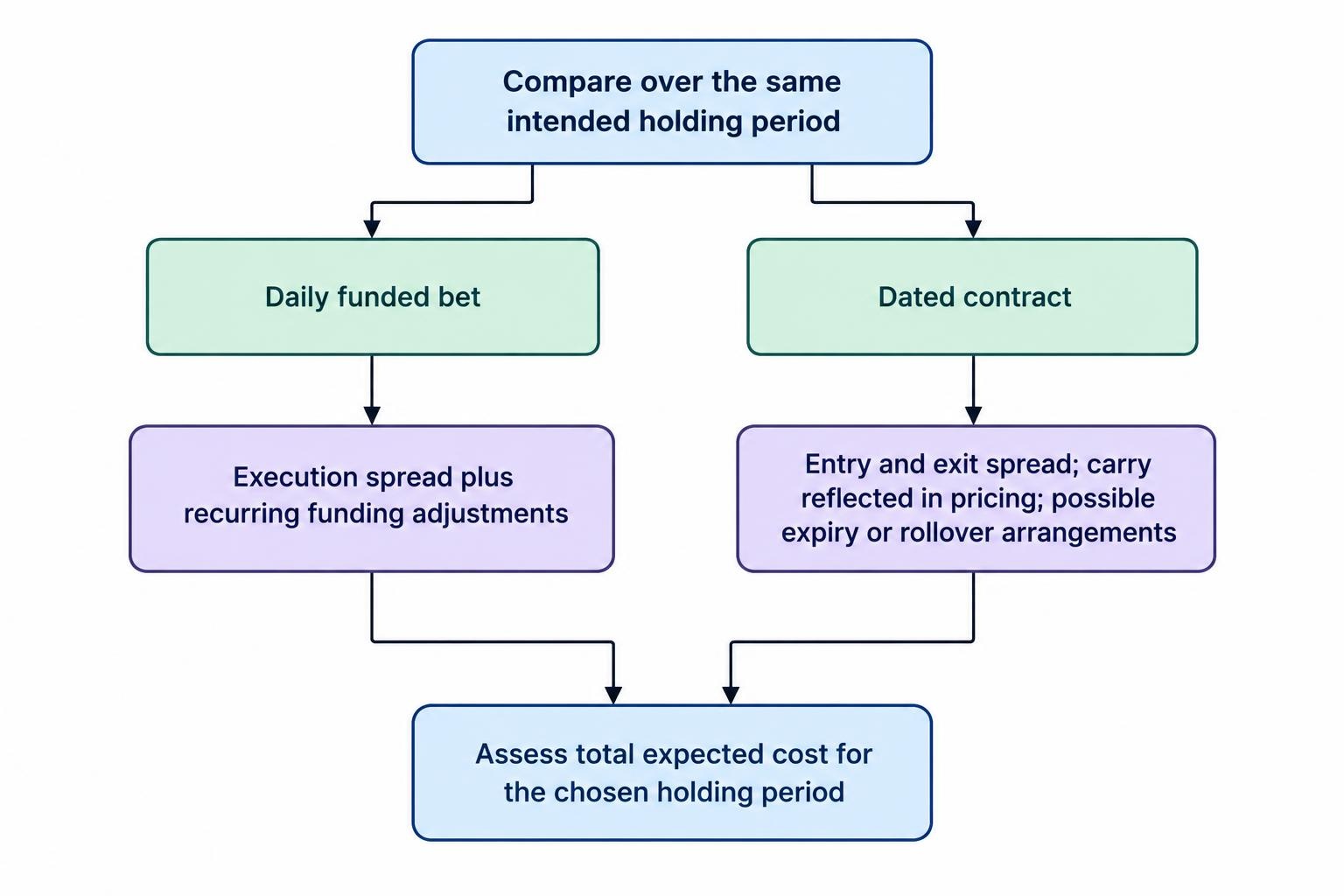
When comparing a daily funded bet with a dated alternative, estimate the cash product’s spread and funding over your intended holding period. Then assess the dated product’s entry and exit spread, embedded carry, expiry arrangements and any rollover costs if you expect to hold beyond expiry.
Do not compare the two opening prices and call the difference a fee. They may represent exposure for different dates, with different dividend and financing assumptions.
The comparison also depends on your likely exit date. A dated product that looks attractive for a long holding period may not be cheapest if you close after two sessions. Conversely, a narrow cash spread can lose its appeal after weeks of daily debits.
The broader product choice is covered in daily funded bets versus futures spread bets. For financing decisions, compare both products over the same intended holding period rather than assuming one is always cheaper.
Measure the effect on profit and available cash
Trading profit and account profit are not always the same figure. A useful reconciliation starts with the result from the actual entry and exit prices, then adds credits and subtracts funding and other separately posted charges.
Suppose the worked example produces £200 of profit from the execution prices after 30 chargeable days. Subtracting £111.78 of financing leaves £88.22 before any other separate adjustments.
If the execution prices already include the bid-ask spread, do not deduct that spread again. The guide to calculating spread betting profit and loss covers the distinction between the price-based result and the final account outcome.
Funding also matters before you close the trade. Include scheduled debits in your cash forecast rather than reserving funds only for adverse price moves. A flat market does not mean an unchanged account balance if holding costs continue to accrue.
This becomes more relevant when several positions remain open together. Add their expected funding charges rather than evaluating each one in isolation. Your margin risk assessment should leave room for both market losses and account charges.
How to compare overnight funding between providers
Compare the same instrument, direction, stake and chargeable period. A long index rate at one firm is not comparable with a short forex swap at another, however neatly the percentages fit into a table.
Request enough detail to reconstruct the cost: the reference rate, markup, day-count divisor, exposure valuation, weekend treatment and any borrowing or conversion charge. If the platform shows a cash estimate, check the position size and number of days behind it.
On constant £16,000 exposure, a one-percentage-point annual rate difference amounts to approximately £13.15 over 30 chargeable days using a 365-day divisor. That saving should be weighed against any difference in execution costs and other charges.
A provider with a narrower dealing spread can therefore cost more for a longer holding period. Equally, a lower funding rate may not compensate for more expensive execution on a trade held for one night.
Use a realistic holding period and a longer stress case. If your expected five-day trade lasts 20 days, would the cost still make sense? A total spread betting cost comparison should answer that question in pounds, not just compare headline spreads.
Check the actual debit against your estimate
Keep the funding terms used when you opened the trade, then reconcile the first posting. Record the instrument, direction, stake, funding valuation, rate, day multiplier and posted amount. For a variable rate or changing exposure, repeat the calculation for each chargeable period.
If the debit differs from your estimate, check these points before assuming the calculation is wrong:
- Did the posting cover several calendar days?
- Was the rate annual, daily or quoted in points?
- Did the exposure, reference rate or borrowing charge change?
- Was a different divisor, rounding method or currency conversion used?
- Does the entry include an adjustment other than financing?
Use the guide to spread betting account statements to distinguish funding entries from realised trading results and other cash adjustments. If the figures still do not reconcile, request a breakdown showing the inputs rather than accepting an unexplained total.
Reducing financing costs without creating another problem
The direct ways to reduce a daily funding bill are to reduce chargeable exposure, shorten the holding period or choose a contract with a lower comparable cost. Each decision should fit the trade rather than exist solely to avoid one debit.
Adding cash to the account does not by itself reduce financing where the contract charges on full notional exposure. Reducing the stake does. In the worked example, halving the stake from £2 to £1 per point would halve the estimated funding charge, assuming the other inputs remained unchanged.
Use position sizing to bring both market exposure and the holding bill within your budget. Do not increase the stake to “earn back” financing; that increases the exposure on which the charge is calculated.
Closing before a cut-off can avoid that funding event if the contract terms allow it, but reopening introduces fresh execution costs and a period without exposure. Compare those costs and risks before turning a funding saving into a more expensive round trip.
Before holding a spread bet overnight, write down the expected charge, the likely holding period and a date for reassessing the position. Treat financing as part of the trade from the start. It should not become a surprise expense discovered only after the market finally moves your way.